
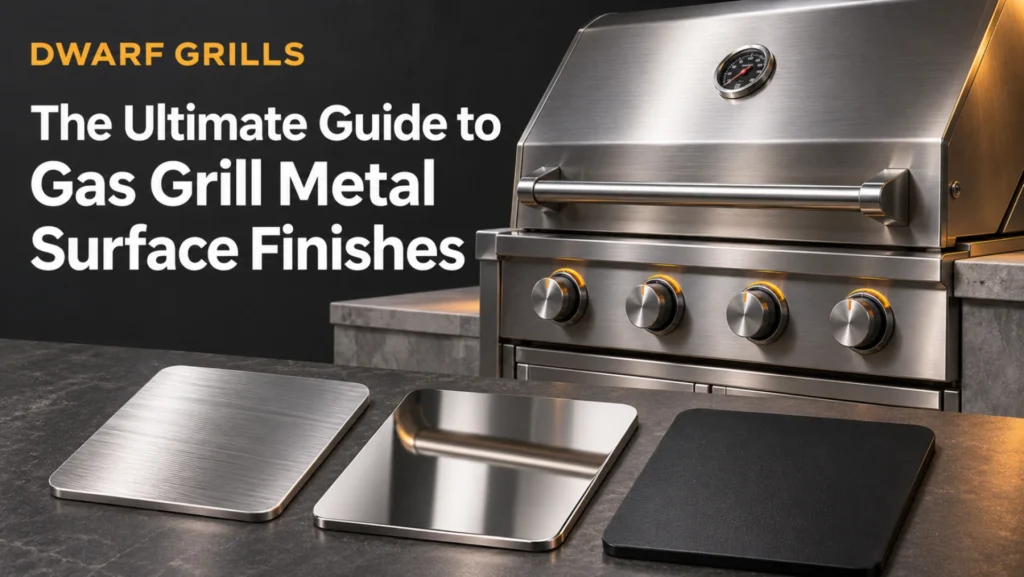
In a physical shops, you can see all kinds of gas grills. Some are made from 304 stainless steel, some use galvanized steel, and others use 316 stainless steel. Their sheet thicknesses also vary.
Many gas grills look bright and refined when sold on Amazon or websites, and other online platforms. Of course, careful lighting and Photoshop often deserve some of the credit.
But if you go to a physical shop, it is a gas grill faces the real test.
You can touch the surface up close, lift the hood, turn the knobs, ignite the burners, and inspect the grill from different angles. That is when you begin to notice that the differences go beyond the base material. The metal surface finishes also vary from one grill to another.
These different gas grill metal surface finishes directly affect the grill’s appearance, ease of cleaning, and long-term corrosion resistance.
I have worked with customers who previously developed gas grills in Guangzhou. They paid close attention to the grade and thickness of the 304 stainless steel. However, they did not clearly specify the brushing grit, surface roughness, post-weld cleaning method, or corrosion-protection requirements for the metal surfaces.
The problems only became clear after the products were exported to Europe and the United States and used outdoors for some time.
Consumers began to complain about rust spots, corrosion beneath chipped coatings, and inconsistent surface colors. The brand owners then realized that poorly specified surface finishing could lead directly to higher after-sales costs.
I have written this guide for gas grill brand owners, buyers, and OEM product development teams.
I will explain 10 common metal surface finishing processes and compare their manufacturing methods, outdoor corrosion resistance, temperature requirements, cleaning difficulty, and cost. I will also explain how to select the right finish for fireboxes, control panels, cooking grates, grill carts, and modular outdoor kitchens.
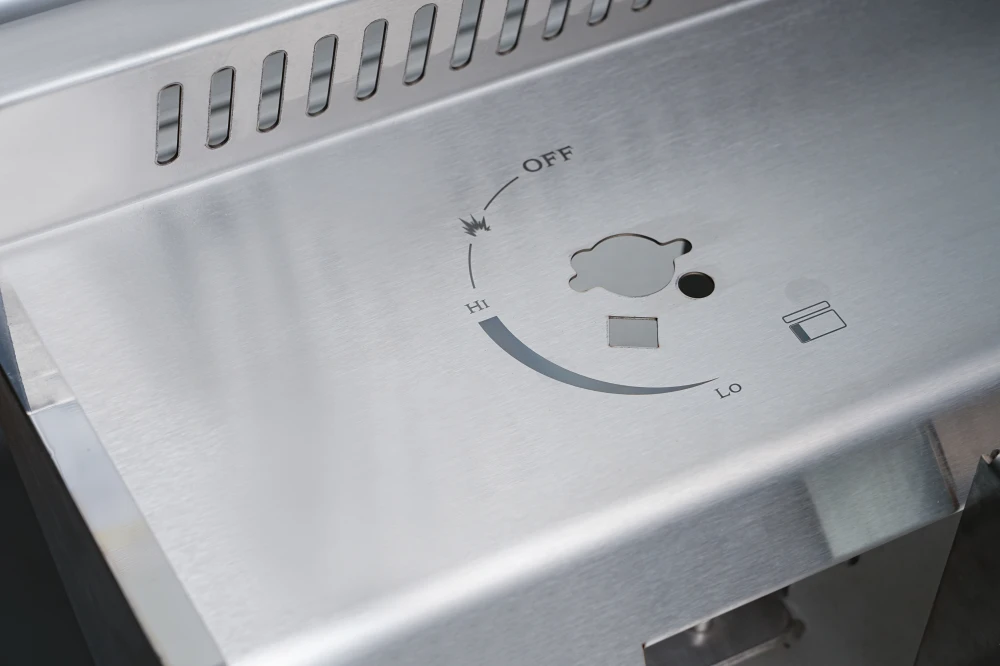
Table of Contents
What Are Gas Grill Metal Surface Finishes?
Gas grill metal surface finishing is the use of mill finishing, mechanical processing, electrochemical treatment, or coating to change a metal surface.
A finish may change: appearance, texture, surface roughness, wear resistance, corrosion resistance, grip, color, heat performance..
But here is an important point:
Not every surface finish improves corrosion resistance.
Metal brushing will change staninless steel surface texture. knurling improves grip friction force.
Powder coating, porcelain enamel, PVD, and electroplating add a layer over the base stainless steel material.
That means buyers should not treat every finish as a protective coating. Some finishes are decorative. Some are functional. Some are both.
I divide the common options into four groups:
| Process category | Surface finishes | Main purpose |
| Mill-supplied finish | Cold-rolled 2B | Provides a flat and uniform starting surface |
| Mechanical finishing | Brushing, mirror polishing, shot blasting, knurling | Changes gloss, roughness, texture, or grip |
| Chemical or electrochemical treatment | Electropolishing, electroplating | Removes surface material or deposits a metallic layer |
| Applied coating | PVD, porcelain enamel, powder coating | Adds color, protection, heat resistance, or decorative value |
Cold-Rolled 2B Finish
2B finish is one of the most common stainless steel sheet finishes.
The steel is cold rolled, annealed, descaled, and given a final light pass using polished rolls. The result is a smooth, uniform surface with a mild reflection.
World Stainless describes 2B as a general-purpose cold-rolled finish that is easier to polish than rougher mill finishes.site: https://worldstainless.org/about-stainless/process-and-production/surface-treatment/
Its main advantage is simple:
It gives the factory a consistent starting material without paying for a decorative finish that the customer will never see.
A 2B surface is also relatively smooth. That can make it easier to clean than a coarse blasted or heavily brushed surface.
Brushed Stainless Steel Finish
Brushed stainless steel is one of the most common decorative finishes used on premium gas grills.
Our Dwarf Grills factory uses abrasive belts, wheels, or pads to create fine lines in one direction.
This finish appears on:
- Gas grill hoods
- Control panels
- Cabinet doors
- Drawer fronts
- Side shelves
- Outdoor kitchen panels
- Decorative trim
Brushed stainless steel has a clean appearance. It also hides light handling marks better than mirror finish.
What Does Brushing Grit Mean?
Common abrasive specifications include 180, 240, and 320 grit.
A coarser abrasive usually creates deeper and more visible lines. A finer abrasive normally creates a smoother and more refined texture.
The type of abrasive, processing pressure, equipment, feed rate and number of processing times will all affect the result.
Oil Brushing vs. Dry Brushing
In grill manufacturing, the factory may use wet or oil-assisted brushing on visible outer surfaces and dry brushing on less visible internal surfaces.
Oil-assisted brushing can produce a more controlled and refined appearance. Dry brushing may leave a coarser texture.
At Dwarf Grills, we can match visible exterior panels and internal parts to different approved appearance requirements. The exact finish should be confirmed through samples because the same abrasive description does not always produce the same visual result.
Recommended Gas Grill Applications
I recommend brushed stainless steel for:
- Control panels
- Outer hoods
- Cabinet doors
- Drawer fronts
- Modular outdoor kitchen panels
For coastal products, I would combine the correct stainless steel grade with a controlled surface roughness, clean fabrication, proper weld treatment, good drainage, and a maintenance plan.
Mirror Polishing
Mirror polishing uses several grinding, polishing, and buffing stages to make a highly reflective stainless steel surface, like a mirror.
It can make a grill look more luxurious.
It also has a small problem: The brighter the surface, the more confidently it reports every fingerprint.
Does Mirror Polishing Improve Corrosion Resistance?
Yes, this surface dealing can improve corrosion resistance, but not too much. The polished surface usually has lower roughness than a coarse brushed surface.
A smoother surface provides fewer places for salt, dirt, and moisture to collect. It can therefore improve cleanability and reduce the risk of surface contamination.
Still, polishing does not change 304 stainless steel into 316.
Recommended Gas Grill Applications
I recommend mirror polishing for:
- Premium decorative strips
- Selected hood details
- Handles
PVD Coating
PVD stands for physical vapor deposition.
The process takes place inside a vacuum chamber. Material from a coating source is vaporized or released and deposited onto the component as a thin film.
PVD can create finishes such as:
- Black
- Gold
- Bronze
- Champagne
- Copper-like tones
- Dark stainless steel
Why Do Grill Brands Use PVD?
PVD gives a brand more design freedom than standard silver stainless steel.
For a premium black gas grill, it can create a metallic appearance that looks different from painted steel or conventional powder coating.
Dwarf Grills has provided PVD finishes for customers who wanted a distinctive premium grill series. (图)
Recommended Gas Grill Applications
I recommend validated PVD systems for:
- Premium control-panel and hood
- Cabinet trim
- Selected stainless steel exterior panels
Shot Blasting
Shot blasting propels abrasive media against a metal surface at high speed.
It can remove some oxide scale and surface contaminants, and also form a specific surface roughness.
In gas grill manufacturing, shot blasting is often more useful as a preparation step than as a final premium finish.
Recommended Gas Grill Applications
I recommend shot blasting for:
- Carbon-steel frames
- Structural brackets
- Coating preparation
- Rust removal
- Selected matte decorative parts
- Components that will receive primer and powder coating
Electropolishing
Electropolishing is an electrochemical process.
Enamel is a process in which porcelain glaze is applied to the surface of a metal and then fired at high temperatures to form a glassy coating.
Why Can Electropolishing Improve Stainless Steel Performance?
First, electropolishing can reduce microscopic roughness. A smoother surface is generally easier to clean.
Second, it can help remove free iron and fabrication contamination.
A stainless steel cooking grate can become contaminated during cutting, welding, grinding, or handling. If workers use tools that have also contacted carbon steel, small iron particles may remain on the stainless steel surface.
Those particles can later rust.
Third, proper electropolishing and cleaning can support a more uniform passive surface condition.
Can Electropolished 304 Stainless Steel Still Rust?
Yes.
Electropolishing improves the surface. It does not change the alloy composition.
Grade 304 stainless steel can still suffer pitting or tea staining in aggressive chloride environments.
Electropolishing is not a substitute for choosing 316 or another suitable grade where the environment requires it.
Recommended Gas Grill Applications
I recommend evaluating electropolishing for:
- Stainless steel cooking grates
- Small precision parts
- Components with difficult-to-polish geometry
- Premium stainless steel hardware
Porcelain Enameling
Porcelain enameling applies a glass-like coating to metal.
Enamel is a process in which porcelain glaze is applied to the surface of a metal and then fired at high temperatures to form a glassy coating.
The US Environmental Protection Agency describes porcelain enamel as a vitreous coating used to improve resistance to water, chemicals, abrasion, and heat.
Recommended Gas Grill Applications
I recommend porcelain enamel for properly engineered:
- Grill hoods
- Fireboxes
- Flame tamers
- Cast iron grates
- Steel grates
- Heat-exposed panels
It works best when the substrate, enamel, geometry, and firing process are developed as one system.
Powder Coating
Powder coating is widely used on grill carts, cabinets, frames, and modular outdoor kitchens.
The factory applies electrically charged powder to a prepared metal surface. The coated part then enters an oven, where the powder melts, flows, and cures.
Powder coating gives brands many choices in:
- Color
- Gloss
- Texture
- Surface feel
- Decorative effect
Dwarf Grills can provide black, gray, green, blue, yellow, or a custom brand color.
Is Heat-Resistant Powder the Same as Weather-Resistant Powder?
No.
Heat resistance and outdoor weather resistance are separate requirements.
A powder may tolerate elevated temperature but still lose color or gloss under UV exposure.
Another powder may offer strong weather resistance but not survive close to the firebox.
Recommended Gas Grill Applications
I recommend validated outdoor powder-coating systems for:
- Grill carts
- Cabinet bodies
- Frames
- Doors
- Drawer fronts
- Side panels
- Side shelves away from intense heat
- Modular outdoor kitchen cabinets
Knurling
Knurling is a mechanical texturing process.The factory uses knurling tools to form regular straight, diagonal or net patterns on the metal surface
Its main function is not to prevent corrosion, but to increase the grip friction.
Imagine a customer cooking steaks.
The customer may be wearing gloves. The customer’s fingers may have grease on them. A completely smooth knob can become difficult to control.
Recommended Gas Grill Applications
I recommend knurling for:
- Control knobs
- Metal handles
- Adjustment rings
Electroplating
Electroplating uses an electrical process to deposit a metal or metal-alloy layer onto a component.
Common decorative systems can include nickel, chromium, copper, zinc, or combinations of several layers.
Electroplating vs. Hot-Dip Galvanizing
These two processes are often confused by buyers.
Decorative nickel-chromium electroplating is typically used to enhance the appearance of metals or provide specific surface properties, with a relatively thin coating.
Hot-dip galvanizing involves immersing treated steel parts into molten zinc to form a protective layer of zinc and zinc-iron alloy.
Hot-dip galvanizing is often used for anti-corrosion protection of certain outdoor carbon steel structural components, and the coating is relatively thick.
There are two processes. Hot-dip galvanizing is applied in more high-end grills.
Recommended Gas Grill Applications
I recommend validated electroplating systems for:
- Control knobs
- Decorative hardware
- Handle fittings
- Fasteners
- Selected brackets
I pay close attention to edges, recesses, pores, plating thickness, adhesion, and corrosion testing.
Which Finish Should You Choose for Each Outdoor Application?
For a general residential courtyard, I usually consider a 304 stainless steel brushed shell or a metal cabinet body that has undergone appropriate outdoor coating treatment.
Brushed stainless steel can offer a relatively classic metallic appearance.
Outdoor weather-resistant powder coating is suitable for black, gray or other colored trolleys and cabinets.
Coastal Villas and High-Salt Areas
For coastal projects, I focus first on the base material.
316 stainless steel or the more costly PVD may be more suitable than 304 for certain environments with high chloride exposure.
For parts that particularly emphasize surface cleanliness and corrosion resistance, appropriate polishing or electrolytic polishing can also be evaluated.
Modular Outdoor Kitchen Cabinets
Modular outdoor kitchens typically include grills, side stoves, cabinet doors, drawers, refrigerators and other modules.
If a powder-coated cabinet body is adopted, attention should be paid to the color and gloss differences between different batches.
For high-end custom projects, powder coating and PVD can provide special decorative effects, but it is necessary to confirm the outdoor weather resistance and the supply of later accessories.
Hotels, Resorts, and Commercial Outdoor Kitchens
For hotels and other frequently used outdoor grills, I will pay more attention to cleaning efficiency and the cost of parts replacement. The brushed surface of stainless steel 304 is a great choice. Although it looks more beautiful than mirror polishing, in an environment with frequent contact and wiping, fine scratches may become more obvious.
Complex knurled textures and rough shot blasting surfaces may also increase the cleaning time.
Frequently Asked Questions
What Is the Best Finish for an Outdoor Gas Grill?
There is no single best finish for every gas grill component.
Brushed stainless steel works well for many exterior panels. Porcelain enamel suits selected heat-exposed parts. Powder coating works well for properly prepared carts and cabinets. Electropolishing can improve cleanability on stainless steel grates.
The correct choice depends on the material, temperature, environment, cleaning method, appearance target, and budget.
Is Brushed or Mirror-Polished 304 Stainless Steel Better?
Brushed stainless steel provides a softer appearance and hides light handling marks better.
Mirror-polished stainless steel is smoother and can resist contaminant buildup, but it shows fingerprints, water spots, and scratches more clearly.
For most grill control panels and cabinets, brushed stainless steel offers a practical balance. Mirror polishing works well for selected decorative parts.
Can Electropolished 304 Stainless Steel Still Rust?
Yes.
Electropolishing can smooth the surface and remove some fabrication contamination. But it does not change the chemical composition of grade 304.
In high-chloride environments, 304 can still suffer tea staining or pitting.
Is PVD Better Than 316 Stainless Steel for Coastal Grills?
No. They perform different jobs.
PVD is mainly a thin decorative or wear-resistant surface treatment. Grade 316 provides higher corrosion resistance through its alloy composition.
A coastal product may use PVD over a suitable stainless steel substrate, but PVD should not be used to disguise an unsuitable base material.
What Is the Difference Between Powder Coating and Porcelain Enamel?
Powder coating creates an organic polymer coating that is cured with heat.
Porcelain enamel creates an inorganic glass-like layer that is fired onto the metal at a much higher temperature.
Powder coating is widely used on carts, cabinets, frames, and other lower-temperature exterior parts.
Porcelain enamel can be suitable for selected high-temperature grill parts when the coating and substrate are properly engineered.
What Is the Difference Between Electropolishing and Electroplating?
Electropolishing removes a very thin layer from a metal surface.
Electroplating deposits another metal or alloy onto the surface.
Electropolishing is often used to improve stainless steel smoothness and cleanliness. Electroplating is used for appearance, wear properties, corrosion protection, or a combination of these functions.
Can OEM Brands Customize Gas Grill Surface Finishes?
Yes.
Based on the material of the parts, structure and project requirements, Dwarf Grills can evaluate different brushed textures, polishing effects, powder coating colors, knurled patterns and other surface treatment schemes.
Some special processes may require additional sample development, outsourcing processing or tooling costs.
The final plan needs to be determined in combination with the product drawings, order quantity and the requirements of the target market.
Conclusion
For gas grills, metal surface treatment not only determines the appearance of the product, but also affects cleaning, maintenance, corrosion resistance performance and after-sales costs.
For an OEM project, I first define the component, environment, temperature, base material, and maintenance requirement. Then I select the finish.
At Dwarf Grills, we provide OEM and ODM gas grills, outdoor kitchens, cabinets, and custom metal components for global brands, importers, and distributors.
If you are developing a new gas grill, I can help your team compare materials, surface finishes, samples, and test requirements before production begins.
Because solving the finish on a drawing is considerably cheaper than solving rust in a customer’s backyard.
