
What types of outdoor grills should a brand develop?
At first, the answer seems simple.
Choose a gas grill. Pick3, 4, 5 burners. Add a few premium features. Done.
But that approach usually creates a product before it defines the customer.
When I plan an outdoor grill, I do not start by asking whether it should have three, four, or five burners.
I start with three bigger questions:
- How will the grill cook?
- How will it be installed?
- Where and how will it be used?
Those questions lead to three different ways of classifying types of outdoor grills:
- Cooking system or fuel: gas grill, charcoal grill, pellet grill, or griddle
- Installation type: portable, freestanding, built-in, drop-in, or modular
- Size and capacity: cooking area, grill width, or main-burner count

These categories describe different things.
A gas grill and a charcoal grill control heat in different ways. A built-in grill and a freestanding grill install differently. And a 3-burner grill serves a different capacity than a 5-burner model.
For example, a 4-burner built-in gas grill and a 4-burner freestanding gas grill may use the same cooking head.
They may even share most of their internal parts.
But they are not the same product.
The freestanding version needs a cart, wheels, side shelves, and usually a safe place for the gas cylinder.
The built-in version needs accurate cutout dimensions, ventilation, clearances, gas access, and service space.
So in this guide, I will show you how I classify outdoor grills for B2B product planning—and how I use that structure to build a product line instead of a collection of unrelated SKUs.
1. Types of Outdoor Grills by Cooking Method
I usually define the cooking system first.
Why?
Because the cooking system determines the basic product logic.
Gas grills, charcoal grills, pellet grills, and griddles can all appear in the same outdoor kitchen. But they generate and control heat in very different ways.
That difference affects the firebox, controls, cooking surface, cleaning process, safety design, maintenance requirements, and bill of materials.
Gas Grills: Fast Heat and Direct Control
In my experience, gas grills provide the most balanced platform for an outdoor cooking product line.
They usually run on LPG, propane, or natural gas.
Gas enters the supply system. The valve controls the flow. The burner mixes the gas with air and creates heat. The user adjusts each burner with a control knob.
Simple.
And that leads to three major advantages:
- Fast preheating
- Direct flame control
- High total heat output
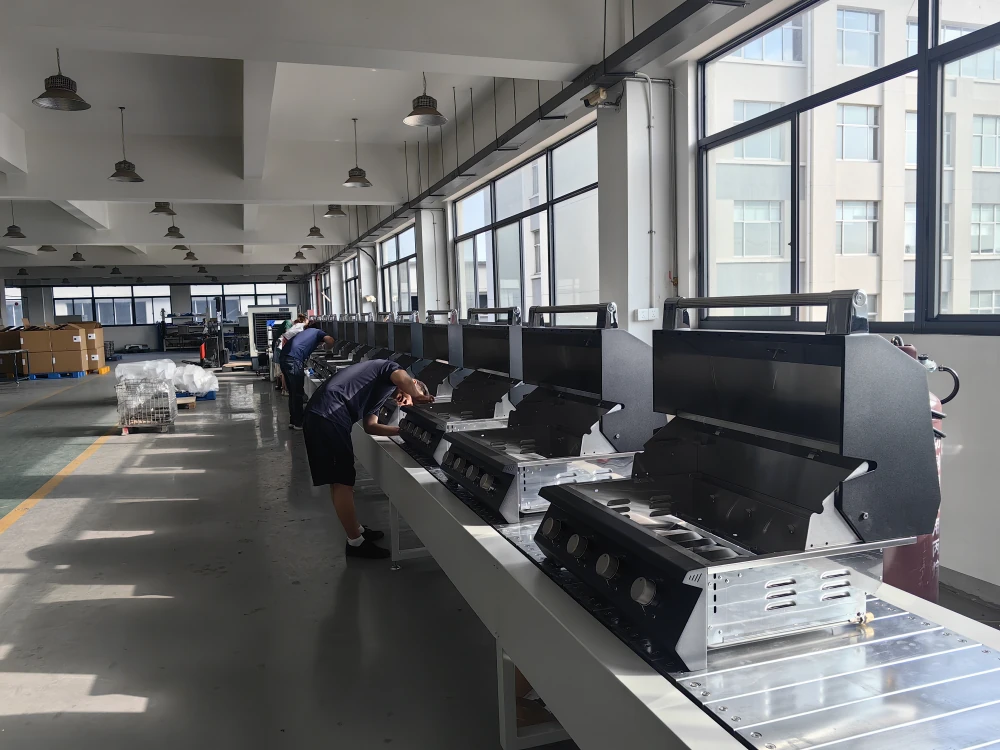
The user does not need to prepare charcoal. Each main burner can be controlled separately. On a larger gas grill, this makes it possible to create several temperature zones at the same time.
For a premium product, I can also add:
- Infrared sear burner
- Rear infrared burner
- Rotisserie system
- Side burner
- Electronic ignition
- Interior lighting
- LED control knobs
I can also develop separate LP and natural-gas versions for different markets.
But here is the bigger B2B advantage:
A gas grill works well as the center of a product platform.
I can start with a 4-burner model. Then I can develop 3-burner and 5-burner versions around the same design language.
After that, I can extend the platform:
Built-in → Freestanding → Modular outdoor kitchen
Now the brand does not have a few unrelated grills.
It has a product family.
Gas grills can serve residential backyards, villas, outdoor kitchens, hotels, resorts, and entertainment areas. That wide application range is one reason they remain central to many outdoor cooking brands.
Charcoal Grills: Heat Control Through Air and Distance
A charcoal grill usually has fewer gas and control components than a gas grill.
But fewer parts do not mean easier engineering.
A gas grill controls heat by changing gas flow through a valve.
A charcoal grill controls heat through:
- The amount of charcoal
- The position of the charcoal
- The airflow through the firebox
- The distance between the charcoal and cooking grate
That changes what I focus on during product development.
Adjustable Charcoal Tray
When the user raises the charcoal tray, the fuel moves closer to the food. The heat becomes more direct.
When the user lowers the tray, the distance increases. That changes the cooking intensity and gives the user more control.
The lifting mechanism must stay stable under heat, ash, grease, and repeated use.
Air Inlets and Exhaust Vents
Charcoal needs oxygen.
The inlet and exhaust design affects the burn rate and temperature control. Poor airflow can make the grill slow to start, difficult to regulate, or easy to extinguish.
Firebox
The firebox must withstand concentrated heat and support the grill structure. Material thickness, deformation resistance, coating, drainage, and ash exposure all matter.
Ash Collection
Ash needs a controlled path out of the cooking chamber. The ash tray should be easy to remove without spreading dust across the grill or patio.
Consumers often choose charcoal for the traditional fire and smoke experience.
From an engineering perspective, I describe the difference this way:
A gas grill gives more heat control to the valves and burner system. A charcoal grill gives more heat control to airflow, fuel position, and firebox design.
A well-designed charcoal grill can offer excellent durability, temperature control, and service life. It is not simply the “simpler” alternative.
Pellet Grills: Wood-Fired Flavor With Automatic Control
Pellet grills use compressed wood pellets as fuel.
The pellets sit in a hopper. An auger feeds them into a fire pot. A motor, controller, fan, and temperature sensor help regulate combustion.
Compared with a charcoal grill, the main benefit is clear:
A pellet grill combines wood-fired flavor with more automatic temperature control.
It works especially well for smoking and low-and-slow cooking. It can also grill, roast, and bake.
But a B2B buyer should not judge a pellet grill only by its stainless steel, welds, or exterior design.
I also inspect:
- Pellet-feed stability
- Auger performance
- Controller accuracy
- Motor reliability
- Fan performance
- Temperature-sensor response
- Fire-pot design
- Electronic spare-part supply
A pellet grill is part cooking appliance and part electromechanical system.
That means after-sales support matters more than many first-time buyers expect.
Outdoor Griddles and Planchas: Direct Contact Cooking
The biggest difference between a griddle and a traditional grill is the cooking surface.
A grill uses an open cooking grate.
A griddle uses a solid metal plate.
That one change creates a different cooking platform.
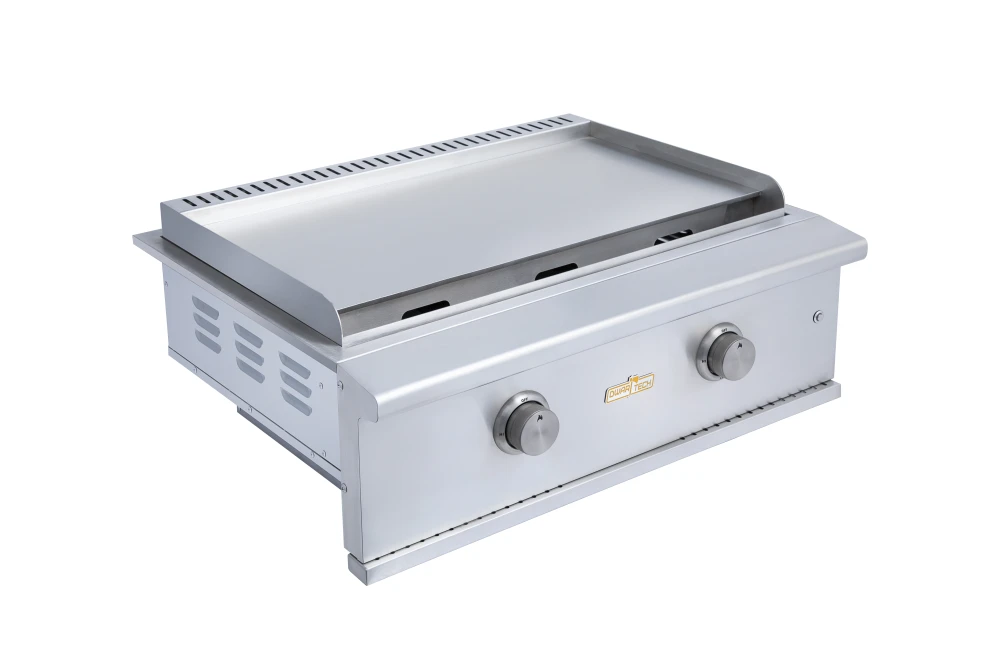
Griddles work well for:
- Steaks
- Burgers
- Fried rice
- Noodles
- Seafood
- Vegetables
- Breakfast food
They also have a relatively low learning curve and a wide menu range.
But a solid steel plate is harder to engineer than it looks.
Dwarf Grills can provide griddle plates up to 10 mm thick. A thicker plate can store more heat and resist deformation, but thickness alone does not guarantee even cooking.
If the burner layout is poor, the center may become hot while the outer edges remain cool.
If the plate is too thin or poorly supported, repeated heating and cooling can cause warping.
For suitable OEM volumes, we can also develop multi-layer composite plancha plates to improve heat transfer and temperature distribution.

[Insert exploded image of the multi-layer composite griddle plate]
Grease drainage is just as important.
Oil must leave the cooking area and enter a removable collection system. Poor drainage creates smoke, cleaning problems, and possible flare-ups around the edges.
A griddle can be freestanding, built into an outdoor kitchen, or used as a module in a larger system. For brand owners expanding beyond traditional BBQ gas grills, it can add new recipes without competing directly with the core grill.
Gas vs. Charcoal vs. Pellet vs. Griddle
| Type | Heat control | Main cooking methods | Main advantage | Typical applications |
|---|---|---|---|---|
| Gas grill | Direct valve control | Grilling, searing, indirect cooking, rotisserie | Fast heat and easy temperature control | Premium residential and outdoor kitchens |
| Charcoal grill | Manual fuel, airflow, and height control | Traditional BBQ, direct and indirect grilling | Charcoal flavor and hands-on fire control | Backyards and enthusiast markets |
| Pellet grill | Electronic feed and temperature control | Smoking, roasting, baking, and grilling | Wood-fired flavor with automated control | Backyards and multi-purpose smoking |
| Griddle or plancha | Direct burner control below a solid plate | Direct-contact cooking | Wide menu range and fast heat transfer | Residential, hospitality, and outdoor food service |
I do not believe one of these outdoor grill types is always better.
They solve different cooking problems.
That is the first decision I make when defining a product.
2. Types of Outdoor Grills by Installation
Once I know how the product will cook, I ask the next question:
How will it be installed?
For a B2B brand owner, this choice affects much more than appearance.
It changes the support structure, packaging, container quantity, installation documents, service access, accessories, and even the sales model.
Portable Grills
Portable grills usually have a compact body and smaller cooking area.
Many use one or two burners, although larger portable designs also exist.
For this category, portability is part of the technical specification.
I look at:
- Product weight
- Carrying handles
- Leg stability
- Hood latches
- Corner protection
- Fuel connection
- Storage dimensions
- Transport safety
From a B2B perspective, a smaller product usually allows more units per container. But portable grills also face more parcel handling and retail logistics.
That means the handle, knob, legs, latch, and corners need strong packaging protection.
A premium portable grill can still use high-grade stainless steel, heavy cooking grates, reliable ignition, and a well-designed burner.
Product size and product quality are two different decisions.
Freestanding Gas Grills
A freestanding gas grill combines the cooking head with its own cart or cabinet.
The lower structure may include:
- Cart frame
- Doors and drawers
- Wheels or casters
- Side shelves
- Gas-cylinder storage
- Side burner
- General storage space
The advantage is easy to understand.
The grill is already a complete outdoor cooking station. The customer does not need to build an outdoor kitchen around it.
They can store it in a garage and roll it onto the patio when needed.
For product development, I check stability, wheel load, center of gravity, gas-cylinder ventilation, hose routing, side-shelf strength, and protection from cooking heat.

Built-In Gas Grills
A built-in grill is designed for installation inside an outdoor kitchen island, countertop, or cabinet system.
Here, I need to define:
- Overall product dimensions
- Cutout dimensions
- Required clearances
- Ventilation requirements
- Insulation requirements
- Countertop relationship
- Gas-connection access
- Future service access
If the installer ignores ventilation, the entire island can develop a safety problem.
If the gas connection becomes inaccessible after installation, even a simple repair becomes expensive.
So a built-in grill is not simply:
“A freestanding grill with the cart removed.”
It is an outdoor appliance designed to work with another structure.
A complete outdoor kitchen can also include:
Side burner + Refrigerator + Sink + Storage + Drawers + Trash bin + Griddle + Pizza oven
The built-in grill becomes the central cooking appliance. The brand can then expand around it.
Drop-In Grills and Cooking Modules
A drop-in appliance is normally installed from the top of the countertop or cabinet.
Its controls may sit above the countertop instead of on the cabinet front.
This design can preserve the clean horizontal lines of the cabinet doors and drawers. It can also make the same cooking module easier to integrate into different cabinet styles.
The main engineering points include top support, sealing, ventilation, drainage, heat protection, and service access.
Modular Outdoor Kitchens
I do not see a modular outdoor kitchen as another grill shape.
It is a product system.
For example, I can combine:
Grill cabinet + Side-burner cabinet + Sink cabinet + Refrigerator cabinet + Storage cabinet + Corner module + Countertop
Then I can use those modules to create:
- Straight-line kitchens
- L-shaped kitchens
- Island layouts
- Entertainment layouts
You can see this approach in the Dwarf Grills modular outdoor kitchen system.
A modular system moves more dimensional control and assembly planning into the factory.
Before shipment, I can check cabinet dimensions, appliance openings, door alignment, surface finish, and module connections.
For the brand owner, the commercial logic also changes.
The brand is no longer selling one grill. It is selling an outdoor cooking system that can continue to expand.
But modular systems introduce new challenges.
The cabinet heights must match. The modules must connect correctly. The countertop material, appearance, and quality must support the brand position.
This is one area where an OEM factory’s visual judgment matters almost as much as its production ability.
Service access must remain open after two cabinets are connected. Shipping also needs early planning because cabinets consume much more container space than grill heads.
3. Gas Grill Sizes: 3B, 4B, or 5B?
Only after defining the cooking system and installation type do I discuss burner count.
What Do 3B, 4B, and 5B Mean?
When I first entered the grill industry, I also wondered what the number and letter meant.
The answer is straightforward:
- 3B = three main burners
- 4B = four main burners
- 5B = five main burners
By common industry convention, a side burner or independent rear infrared burner is not normally included in the main-burner count.
For example, a Dwarf Grills premium 4B model will commonly mean:
Four main burners + one rear infrared burner
Most of our series include a rear burner unless the model or customer specification requires another configuration.

3-Burner Gas Grills
Three independently controlled burners can create useful cooking zones in a relatively compact product.
A 3B grill works well for small patios, balconies, and compact outdoor kitchens. Its firebox is normally narrower than the 4B or 5B version in the same family.
A premium 3B grill can still include:
- Heavy stainless steel cooking grates
- Cast stainless steel burners
- Interior lighting
- LED controls
- Double-layer hood
With a high-output burner system, such as a suitable H-shaped layout, a 3B grill may approach the total heat output of some 4B designs.
But total heat is not the only goal.
The engineering challenge is to create useful heat zones inside a smaller firebox without making the product feel crowded.
4-Burner Gas Grills
Four main burners usually provide a strong balance between cooking capacity and overall size.
I can run one side at high heat, keep the middle at medium heat, and turn off another zone for indirect cooking.
A premium 4B configuration may include:
Four main burners + Rear burner + Interior lighting + LED knobs + Rotisserie + Optional infrared sear zone
But four burners do not define the quality of the grill.
Material, burner design, valve control, heat distribution, grate height, hood volume, and airflow still determine performance.
For a brand owner, the 4B model often works well as the center of a product family.
The brand can develop a more compact 3B version below it and a larger 5B version above it. It can also create built-in and freestanding versions around the same design direction.
5-Burner and Larger Gas Grills
A 5B grill offers more potential cooking area and more independently controlled temperature zones.
It suits large villas, luxury outdoor kitchens, entertainment spaces, and hospitality projects.
But a larger grill creates larger engineering problems.
As the firebox becomes wider:
- Heat distribution becomes harder to control
- Total gas demand increases
- Structural rigidity becomes more important
- Material use increases
- Packaging volume grows
- Shipping risk rises
This is why scaling a 4B grill into a 5B model requires more than stretching the drawings.
Comparing 3B, 4B, and 5B Gas Grills
| Configuration | Product position | Main advantage | Engineering challenge | Typical application |
|---|---|---|---|---|
| 3B | Compact to mid-size | Smaller footprint | Creating useful heat zones in limited space | Small patios and compact outdoor kitchens |
| 4B | Mid-range to premium | Balance of capacity and heat-zone control | Even heat across a wider firebox | Premium residential outdoor kitchens |
| 5B+ | Large and premium | More capacity and temperature zones | Gas demand, rigidity, heat distribution, and packaging | Large villas and entertainment spaces |
So which one should a brand choose?
The answer depends on the application—not on which number looks better in a brochure.
4. Choosing an Outdoor Grill by Application
In many projects, the application tells me more than the product catalog.
Small Patios and Compact Outdoor Spaces
I start with the available space.
If the user wants mobility and storage, I consider a compact freestanding grill.
If the space already includes a permanent outdoor kitchen, a smaller built-in grill may work better.
But I do not automatically lower the product grade because the space is small.
A luxury apartment terrace or compact villa may still need a premium grill.
Small describes the footprint.
It does not describe the customer’s quality expectations.
Residential Backyards
A residential backyard gives me more choices.
If the user wants fast ignition, simple controls, and mobility, I consider a freestanding gas grill.
If the user enjoys managing a live charcoal fire, I consider a charcoal grill.
If long smoking sessions are important, I consider a pellet grill.
If the menu includes breakfast, burgers, seafood, vegetables, and flat-top cooking, I consider a griddle.
My rule is simple:
Cooking behavior should determine the cooking platform.
I do not force every application into a gas grill simply because the factory is good at manufacturing gas grills.
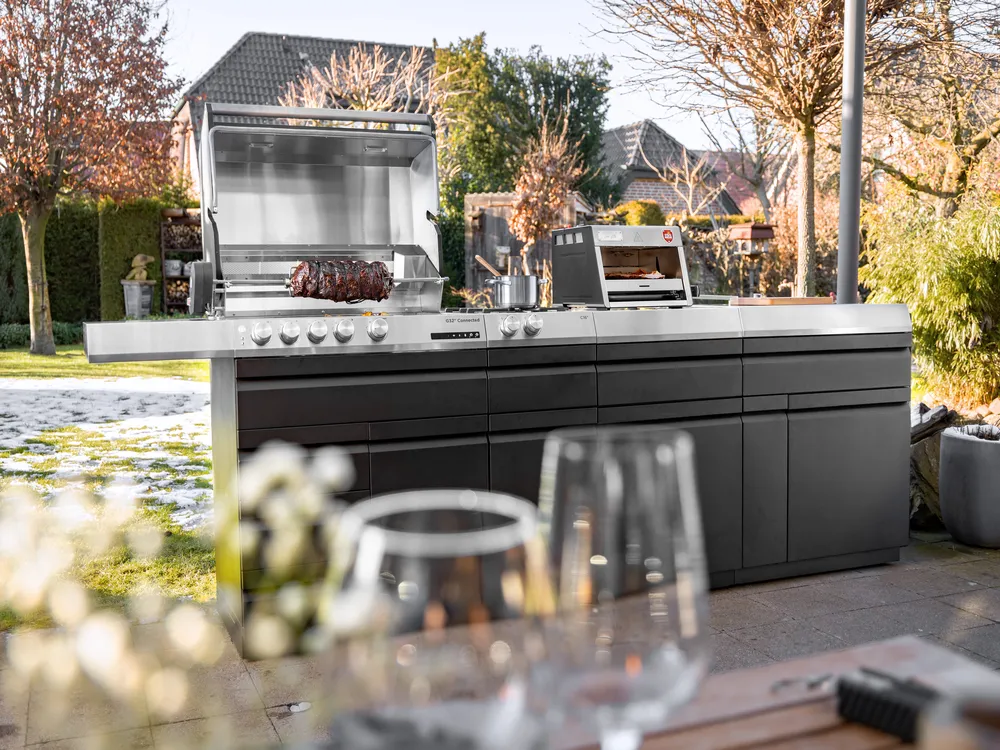
Premium Outdoor Kitchens
For a premium outdoor kitchen, I normally start with built-in cooking appliances.
A typical package may include:
Built-in gas grill + Side burner + Refrigerator + Sink + Drawers + Storage
Then I can add:
Griddle + Pizza oven + Charcoal module
At this point, the commercial value changes.
The brand is no longer competing for one grill sale. It can occupy several positions inside the same outdoor kitchen.
Design unity becomes much more important.
The grill, side burner, drawers, refrigerator surround, and cabinets should look as if one brand designed them—not as if five suppliers met by accident.
Modular Outdoor Kitchens
For modular outdoor kitchens, I focus on standardization and compatibility.
I want the same core modules to support several layouts:
Straight line → L-shape → Island
If one group of modules can create all three layouts, the brand can offer more kitchen solutions without multiplying its SKU count.
That is where a product platform begins to create real B2B value.
Coastal Outdoor Kitchens
Coastal projects demonstrate an important point:
The grill category is not the complete specification.
I may still use a 4B built-in gas grill.
But the material strategy must change.
Salt and humidity increase corrosion risk. So I pay more attention to:
- Exposed fasteners
- Stainless steel grade
- Cabinet material
- Drainage
- Crevices
- Surface treatment
- Areas that can trap water
The product category stays the same.
The environment changes.
So the specification must change with it.
Hotels, Resorts, and Hospitality Projects
For hospitality projects, I focus on:
- Cooking capacity
- Frequency of use
- Cleaning time
- Maintenance access
- Replacement parts
- Product durability
- Installation control
I do not add a feature just because it looks good in a brochure.
If staff cannot clean, repair, or replace it easily, the feature may create more cost than value.
For high-use projects, serviceability and production repeatability often matter more than the number of features.
5. How I Plan an Outdoor Grill Product Line
When I work with a brand owner, I do not recommend developing ten unrelated grills at the same time.
That approach can create ten engineering systems, ten packaging plans, more drawings, more unique parts, and a larger spare-parts burden.
I prefer a platform strategy.
For example, I can start with a gas-grill platform:
4B → 3B + 5B
Then I can extend the 4B design:
Built-in → Freestanding → Modular outdoor kitchen integration
Next, I can expand the cooking ecosystem:
Gas grill → Side burner → Griddle → Pizza oven → Storage → Refrigerator → Sink
Now the range becomes a true product family.
That improves engineering efficiency. It can also strengthen brand recognition because the products share a consistent design language.
But I do not force parts to be shared when performance requires a different solution.
My rule is:
Standardize where function allows it. Customize where performance requires it.
This gives the brand owner the efficiency of a product platform without sacrificing the reason customers buy the products in the first place.
Conclusion: Start With the Application
I do not place gas, charcoal, pellet, griddle, portable, built-in, freestanding, 3B, 4B, and 5B into one flat list.
They answer different questions.
Cooking type tells me how the product cooks.
Installation type tells me where and how the product will be installed.
Cooking area and burner count tell me how much capacity the product can offer.
But burner count alone cannot tell me whether a grill is premium, heats evenly, or fits a target market.
So when I begin a grill project, I ask:
Where will this product be used? Who will use it? What job must it perform?
Then I define the product in this order:
Application → Cooking type → Installation type → Size → Burner configuration → Features → Materials → Final specification
For a brand owner, this process does more than select one grill.
It creates the foundation for a product line that can keep growing.
