
Spring and fall are ideal seasons for outdoor cooking.
And if you are a gas grill brand owner or importer, these are often the seasons when you start planning your next product line.
Maybe you are looking for a qualified manufacturer. Or perhaps you want to understand important gas grills question:
How are gas grills made?
If so, you are in the right place.
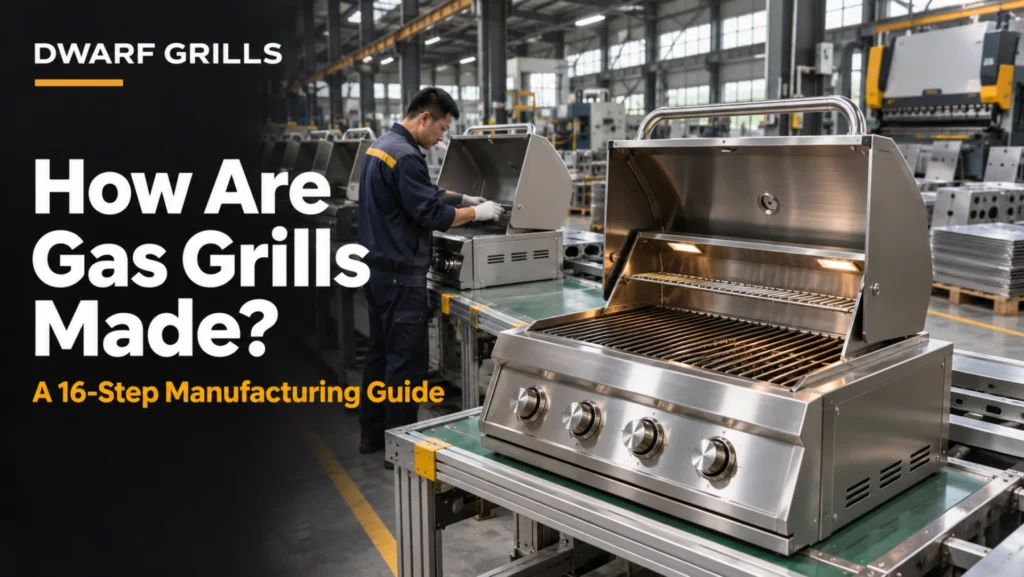
In this guide, I will show you how gas grills are manufactured, from engineering design and metal fabrication to testing, packaging, and container loading. Follow me inside a real OEM factory to see the complete gas grill manufacturing process.
I will also explain what happens at each production stage, where quality problems usually begin, what affects manufacturing cost, and what an OEM buyer should verify before approving mass production.
Let’s begin inside the Dwarf Grills-gas grill.
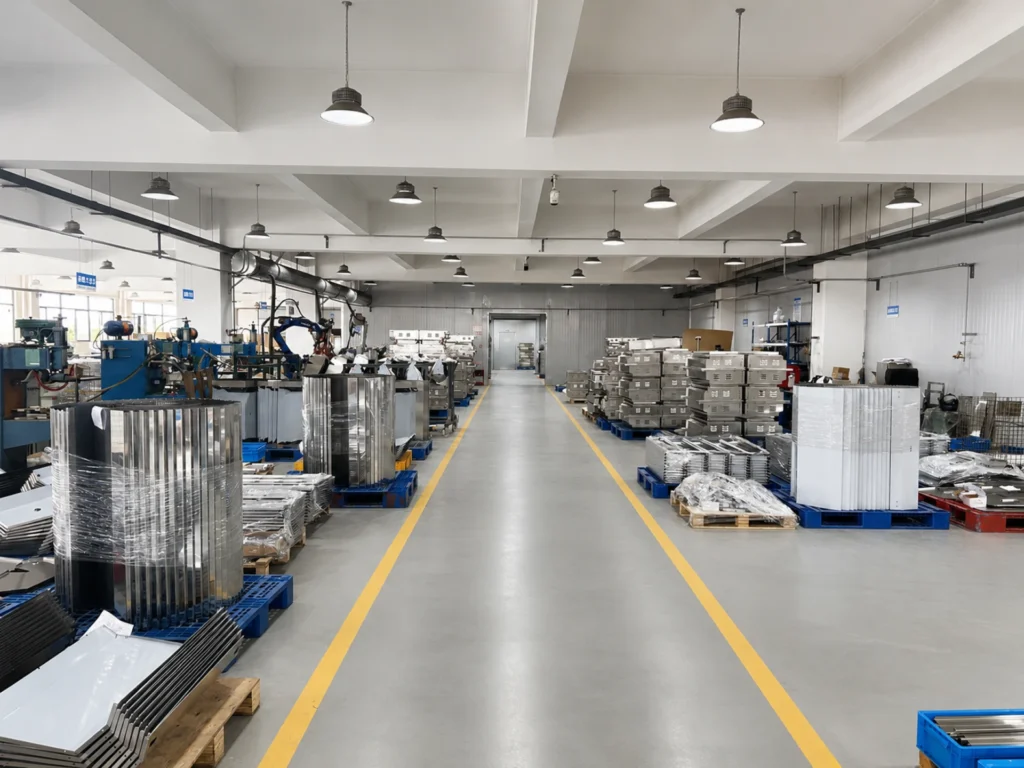
Table of Contents
1. What Parts Make Up a Gas Grill?
From the outside, a gas grill can look simple.
Many people see a stainless steel body, several burners, and a set of cooking grates.
In fact, it combines sheet-metal structures, a gas-control system, a combustion system, a control panel, and cooking accessories.
I usually divide a gas grill into three main groups.
1.1 Metal Structural Components
The metal structure determines the grill’s overall shape, mechanical strength, and assembly accuracy.
The main structural sections include:
- Firebox
- Hood
- Control panel
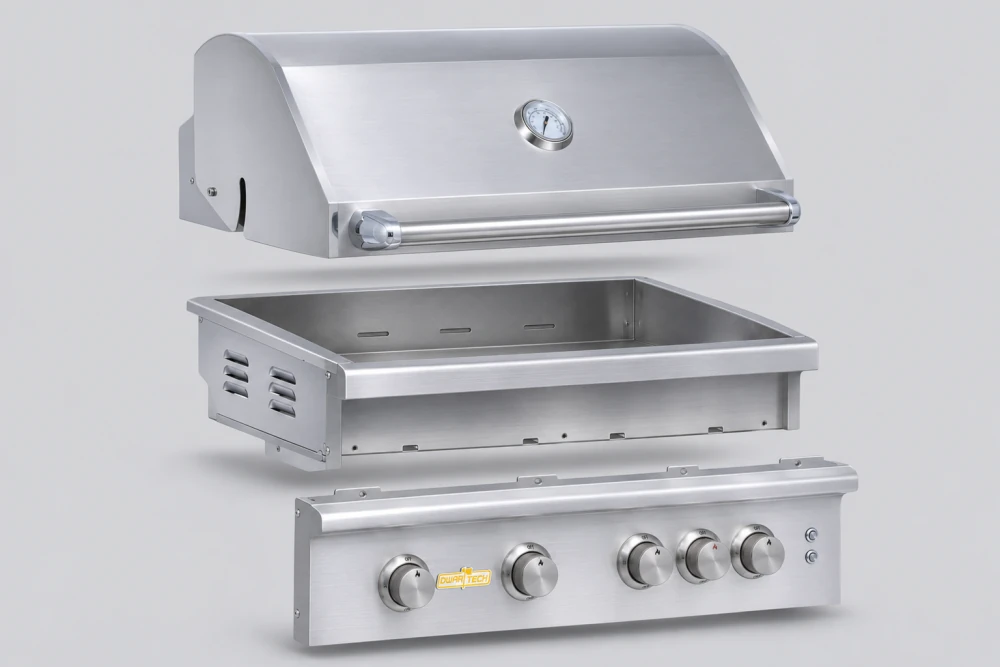
These components normally pass through laser cutting, punching, bending, welding, grinding, and surface-finishing processes.
1.2 Burn and components
This will include
- Main burners
- Gas valves
- Manifold
- Gas orifices
- Regulator and supply components
- Ignition devices
- Flame-failure devices on applicable models
Gas enters the grill through the supply. It then passes through the relevant pressure-control components, valves, and orifices before reaching the burners.
Inside each burner, the gas mixes with air and burns through the burner ports.
One detail is especially important:
LPG and natural gas do not use the same supply conditions.
Dwarf Grills configures the valves, orifices, regulators, and related supply components according to the customer’s specified gas type and target market.
1.3 Cooking Components and Accessories
The main cooking components and accessories include:
- Cooking grates
- Flame tamers
- Warming racks
- Grease trays
- Hood thermometers
- Rotisserie components
- Interior lighting systems
Stainless steel flame tamers and ceramic briquette systems transfer and store heat differently. They also have different cleaning, maintenance, replacement, and cost requirements.
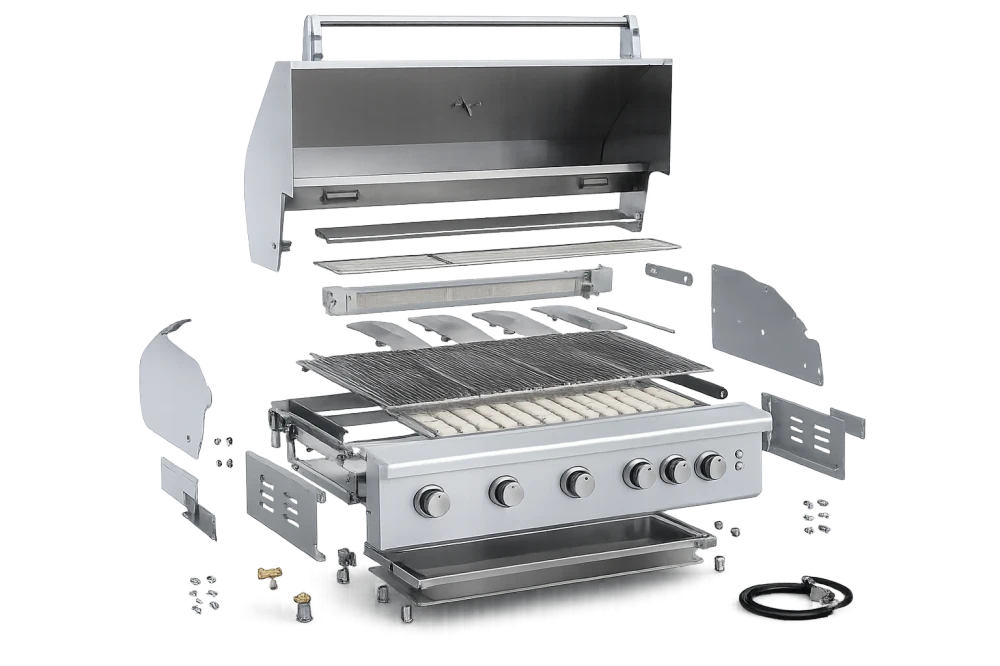
If you want to examine these components in more detail, you can read our guides to gas grill components, types of grill grates, and types of flame tamers.
How Are Gas Grills Manufactured?
From gas grill development to container loading, I divide the complete manufacturing flow into 16 main stages.
Some parts are manufactured at the same time. Some purchased components arrive while the sheet-metal body is being fabricated. Testing may also send a design back to an earlier stage for correction.
In real OEM gas grill manufacturing, the process is controlled—but it is rarely a neat little parade.
Step 1: Product Development and Engineering Design
I believe the first step in manufacturing a gas grill is not cutting stainless steel. It should be how the product should work.
For an OEM project, a customer may provide complete engineering drawings. Another customer may arrive with a reference photo, a target price, and a few feature ideas.
For example, Dwarf Grills’ US brand owner may want to develop a premium 36-inch built-in gas grill with:
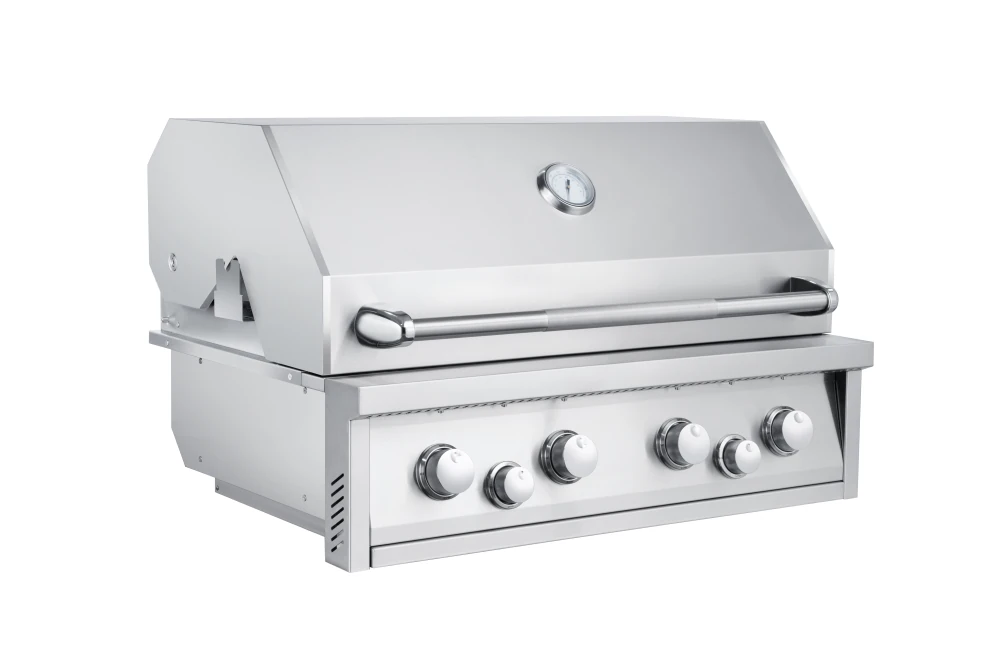
- Four main burners
- A rear infrared burner
- LED control knobs
- A double-layer hood
Before manufacturing starts, we need to confirm the key product parameters.
These normally include:
- Gas type
- Burner options
- Total cooking area
- Firebox dimensions
- Component materials
- Sheet thickness
- Target heat input
- Installation type
- Target-market compliance requirements
The engineering team then uses 3D design software to create the product structure and assembly model. We also prepare a bill of materials, or BOM, for customer review and internal production control.
Once, a customer asked us about the problems they might encounter when manufacturing gas grill. We once found that the size of the oil collection tray provided by the customer in the design drawings was inappropriate, which posed a risk of oil leakage.
Insufficient thermal expansion space in the combustion chamber may lead to structural deformation and other issues at high temperatures.
For brand owners, the early-stage engineering design not only affects product performance but also determines subsequent mold investment, material utilization rate and production costs.
Step 2: Prototyping and Sample Approval
Once the engineering drawings are ready, the next step is to turn the design into a physical product.
We normally begin with a design-for-manufacturing analysis, commonly called DFM.
Then we manufacture the prototype and perform complete-unit tests to verify whether the design is practical.
Depending on the project, our development testing can include:
- High- and low-temperature tests
- Rain exposure tests
- Full-load operating tests
- Ignition tests
- Flame-stability tests
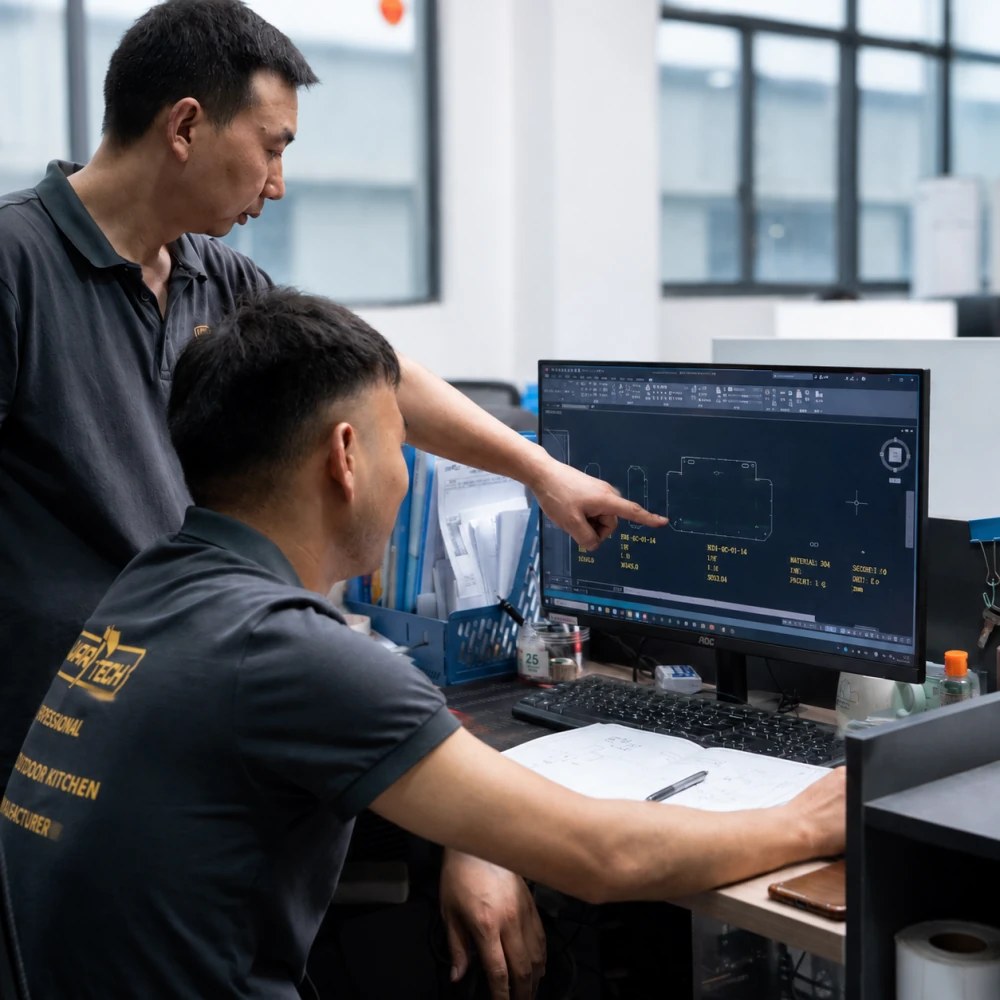
We often plan these tests with the intended certification requirements in mind.
What Problems Can a Prototype Reveal?
Prototype testing can expose problems that 3D drawings may miss, such as:
- Interference between valves and the control panel
- Hood distortion at high temperatures
- Poor grease-tray access
- Ignition wires placed too close to heat
Step 3: Raw Material Purchasing and Inspection
After the factory prototype passes testing and the customer approves the sample, the factory prepares materials according to the production plan.
Common metals used in stainless steel gas grill manufacturing include:
- 304 stainless steel
- 316 stainless steel
- 201 stainless steel for selected structures or coated applications
- Carbon steel for suitable coated components
- Galvanized steel for appropriate low-temperature applications
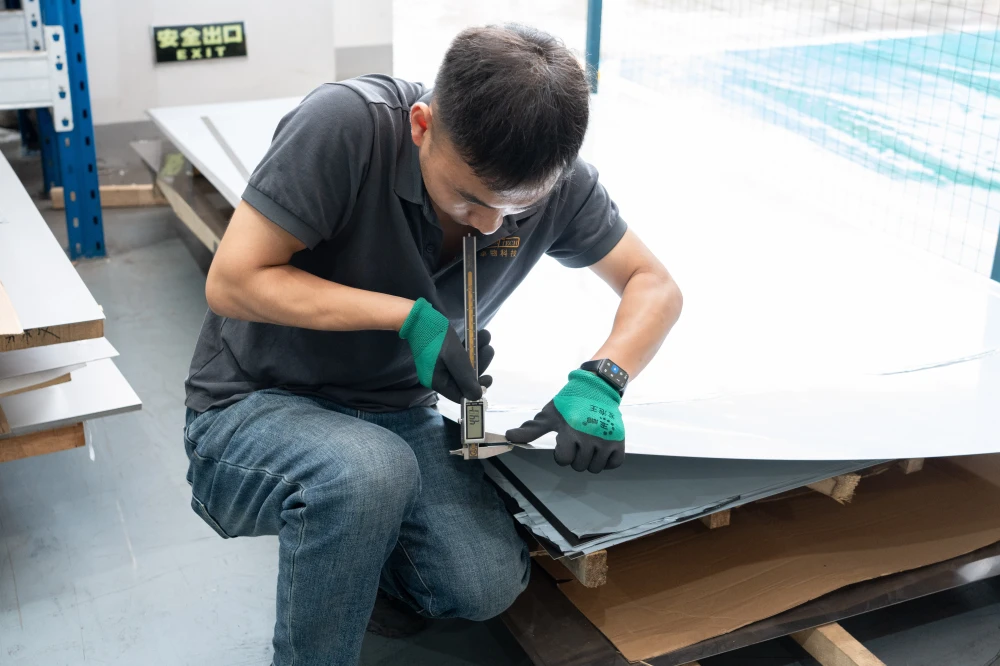
Grade 304 stainless steel is widely used for gas grill fireboxes, housings, control panels, and internal components because it offers a useful balance of corrosion resistance, fabrication performance, and cost.
For instance, some internal brackets may focus more on structural strength and cost, while external panels need to take into account both corrosion resistance and decorative appearance.
At Dwarf Grills, our quality inspectors will conduct incoming material inspections immediately upon the delivery of raw materials by suppliers, including checking the thickness, size and quantity of the sheets.
For OEM orders with clear material requirements, material certificates and other verification records should also be checked according to the project needs.
Step 4: Laser Cutting
After the stainless steel sheets pass incoming inspection, they enter the sheet-metal fabrication process.
Laser cutting is one of the main front-end operations. Dwarf Grills has three high-speed Han’s Laser cutting machines.
For the equipment used in our factory, the stated cutting accuracy is:
- Fast-cutting mode: ±0.10 mm
- High-precision mode: ±0.05 mm
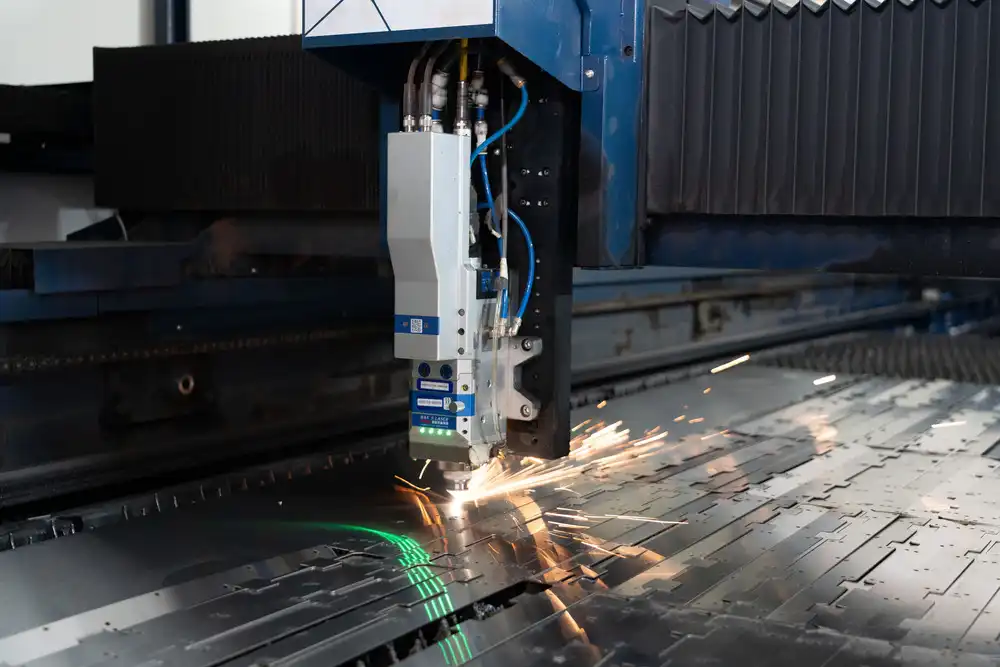
Actual part acceptance still depends on the drawing, material, thickness, geometry, equipment condition, and inspection method.
Why Does Laser-Cutting Accuracy Matter?
Engineers nest the part drawings to reduce material waste. The laser then cuts firebox panels, hoods, control panels, brackets, and cabinet parts.
Accurate cutting keeps holes and edges aligned. This reduces assembly problems, uneven gaps, rework, and production costs.
Step 5: CNC Punching and Stamping
Laser cutting can produce many sheet outlines and holes,but not every sheet-metal feature is best made with a laser.
Some components require:
- Punched holes
- Louvers
- Ribs
- Flanges
- Embossed forms
- Local forming
- Special mounting structures
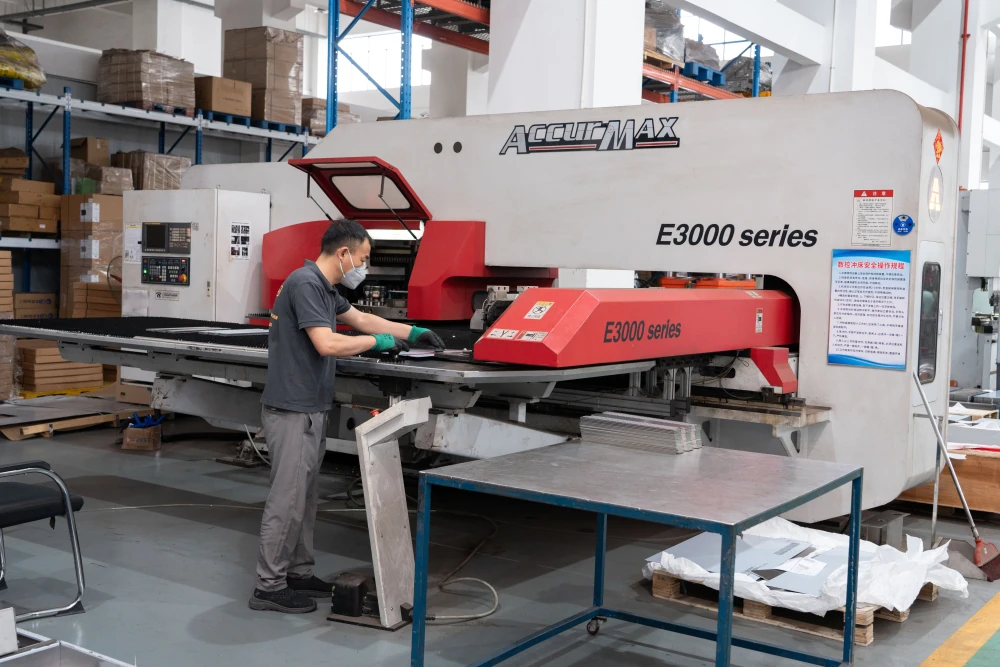
Examples include firebox ventilation openings, cabinet reinforcement ribs, and formed mounting features.
Dwarf Grills operates a 42-station CNC turret punch and a 200-ton hydraulic press.
By combining different tools and dies, we can produce bridge-shaped features, reinforcement ribs, raised structures, and other sheet-metal forms.
Why Is Stamping Valuable in Gas Grill OEM Manufacturing?
Stamping improves gas grill part strength, and gas grill production speed while reducing welding.
Flexible tooling suits small custom orders. Dedicated dies are better for stable, high-volume production because they improve repeatability and lower unit costs.
Step 6: Deburring and Edge Treatment
After laser cutting and punching, sheet-metal components can have burrs, sharp edges, scratches, local oxidation, or processing marks.
These problems must be treated according to the product requirement.
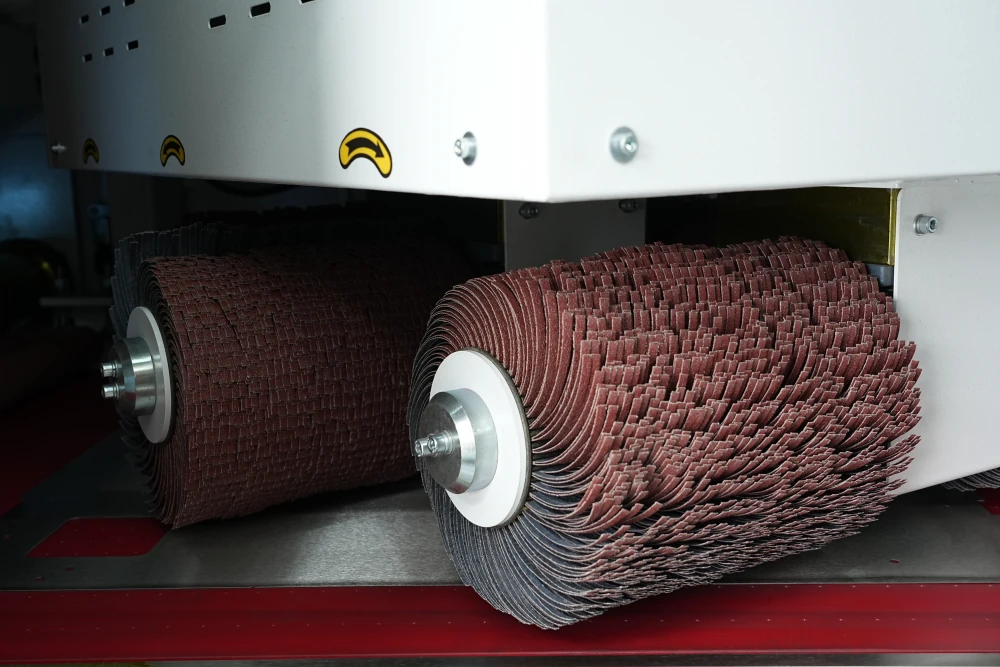
Dwarf Grills uses deburring equipment to process exposed metal edges and improve part consistency.
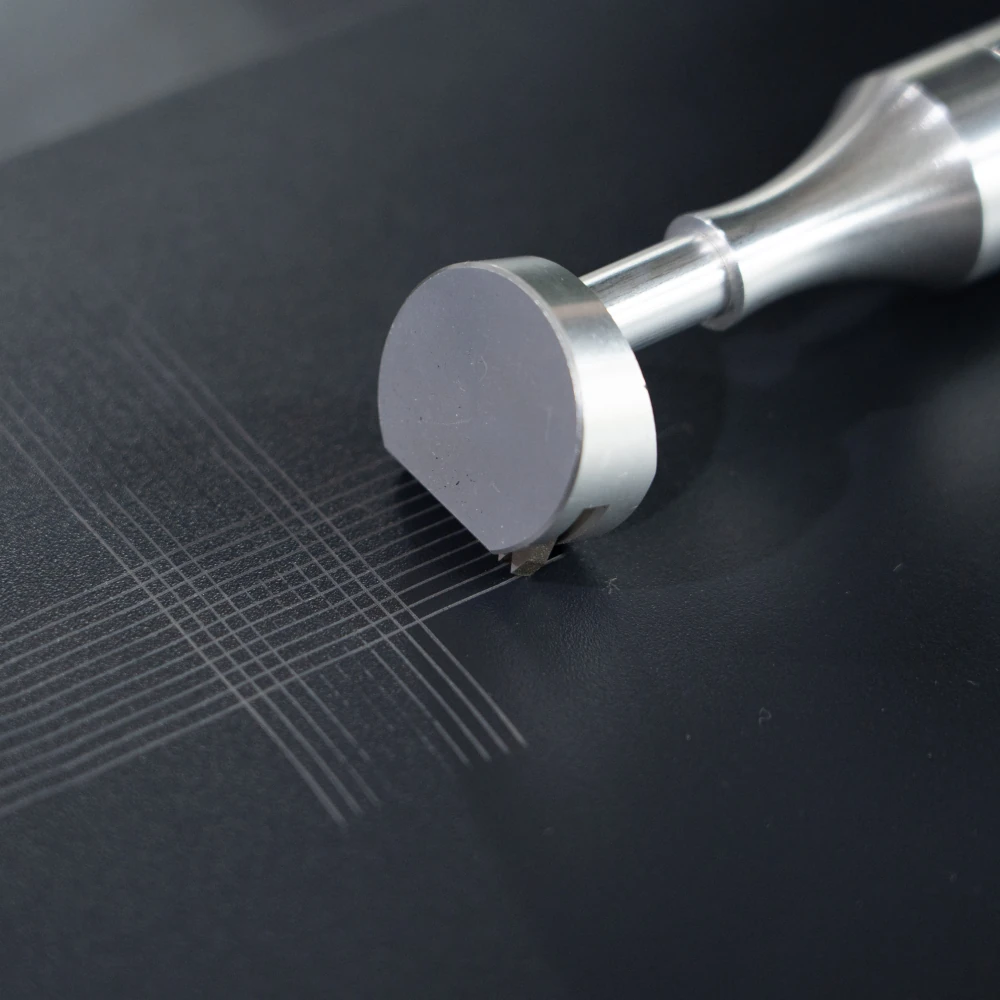
Our workers also use a UL sharp-edge tester to check relevant areas and reduce the risk of sharp edges cutting production workers, installers, or end users.
Deburring machine will providea more safer, cleaner edges that protect workers, users, wiring, hoses, and surface coatings.
Step 7: Bending and Hydraulic Forming
After deburring, flat metal parts move to the bending stage.
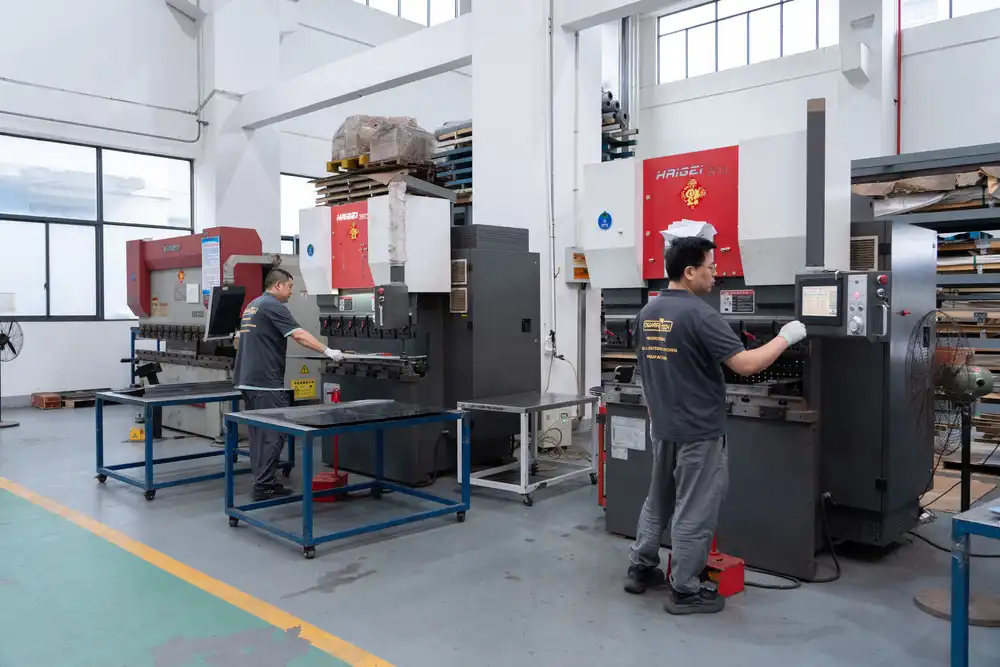
Dwarf Grills operates six bending machines. Workers use them to form fireboxes, hoods, cabinets, control panels, and other three-dimensional structures.
Our high-precision CNC bending equipment includes all-electric servo machines and hybrid electro-hydraulic machines. The equipment includes Accurpress and Haeusler machines, selected for stable operation and accurate bending control.
Engineers must control:
- Bend angle
- Bend radius
- Bend position
- Springback compensation
- Part dimensions
- Surface protection
For larger flanges, drawn holes, and selected one-piece structures, Dwarf Grills can use a 100-ton hydraulic forming system.
How Do We Control Flatness and Consistency?
Our control approach includes:
- Precision tooling from Japanese supplier Kyokko
- Controlled core bending data for products with the same specification
- Restrictions against unauthorized parameter changes
- Trained machine operators
- Planned sampling inspections
- Angle-gauge inspection
- Vernier-caliper inspection
- Granite surface-plate checks
I summarize the process this way:
Accurate equipment → standardized precision tooling → controlled programming → disciplined process inspection
That sequence is far more reliable than asking an operator to “make it look about right.”
Step 8: Welding and Structural Fabrication
Once bending is complete, the sheet-metal parts must be joined into complete structures.
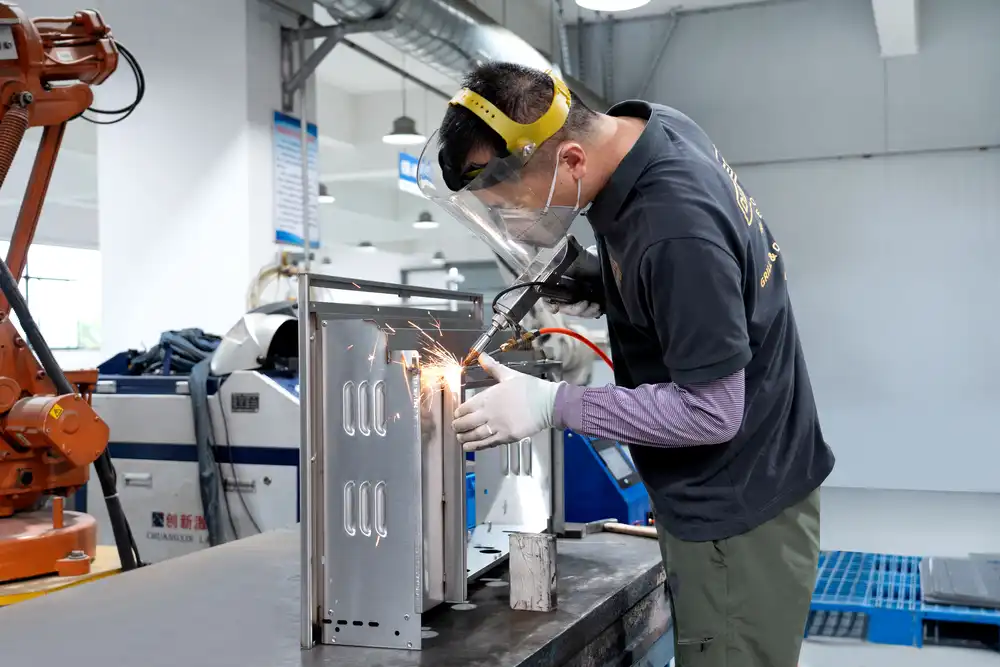
Sheet metal parts such as combustion chambers, furnace covers, internal brackets and door and drawer assemblies
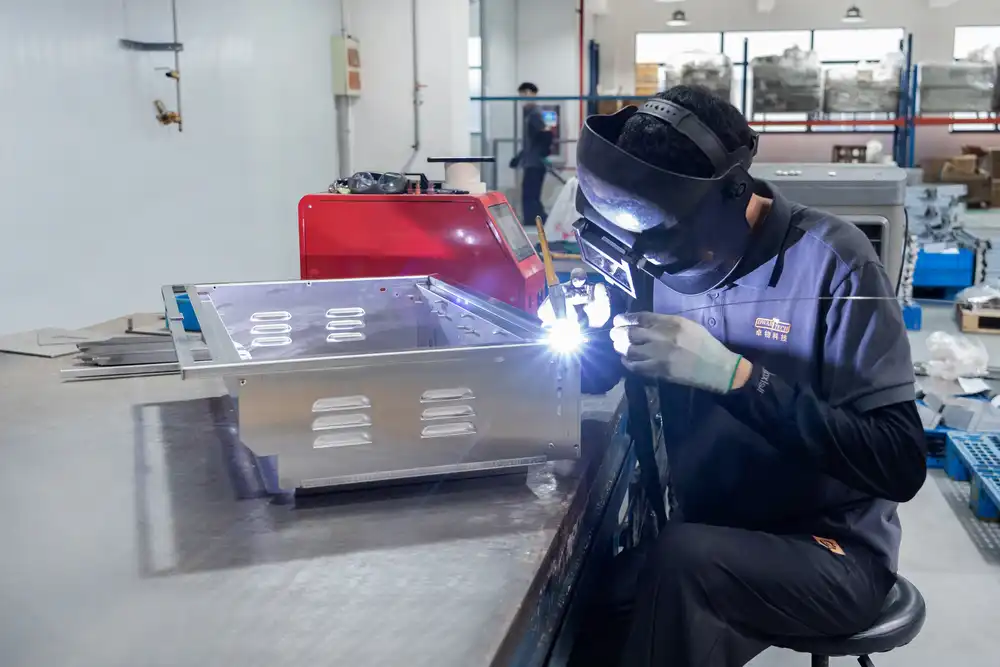
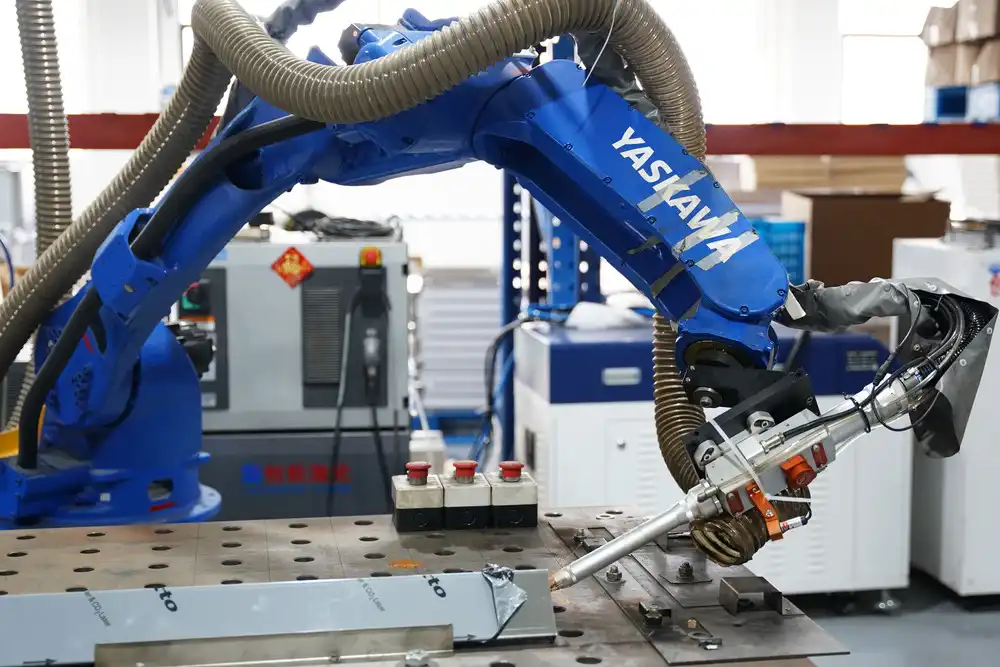
At Dwarf Grills, our production mix is approximately 70% robotic welding and 30% manual welding.
This combination supports repeatability in volume production while preserving the flexibility required for complex and customized structures.
Which Welding Processes Do We Use?
| Welding method | Main application | Main advantage |
| Robotic laser welding | Long straight seams, regular curves and standardized high-volume parts | Stable speed, repeatable positioning and consistent seams |
| TIG welding | Thin stainless steel and areas requiring controlled, attractive welds | Controlled heat input and high-quality precision welding |
| Manual welding | Complex locations, custom batches, repair welding and areas inaccessible to robots | High flexibility for non-standard structures |
| Resistance welding | Sheet-metal components suitable for resistance joining | Efficient and repeatable joining |
Our welding equipment includes three robotic welding systems from Yaskawa and ABB.
How Do We Control Welding Distortion?
Thin stainless steel can distort when local heating and cooling make uneven expansion and contraction.
This will affect hood flatness, firebox dimensions, panel alignment, and final accuracy.
We use several methods to manage this risk.
Welding Procedure Qualification
We select welding parameters according to the material, sheet thickness, joint design, and product structure.
Dedicated Fixtures
Fixtures position and hold mass-production components during welding. This reduces movement and dimensional drift.
Controlled Welding Sequence
Segmented welds, symmetric sequences, and other controlled methods help reduce heat concentration and shrinkage distortion.
For specific workpieces, specialized processes such as water-assisted welding may be evaluated where appropriate.
Standardized Process Cards
Process documents define items such as current, voltage, shielding-gas settings, and welding speed. This reduces uncontrolled variation between batches and operators.
What Welding Quality Do We Require?
We inspect welding from three angles.
Weld Appearance
The weld should be uniform and transition smoothly into the surrounding material. It should not show unacceptable undercut, excessive buildup, surface porosity, or cracking.
Structural Strength
Depending on the component and its intended load, we may use drop, tensile, bend, or other relevant tests to verify joint reliability.
Post-Weld Treatment
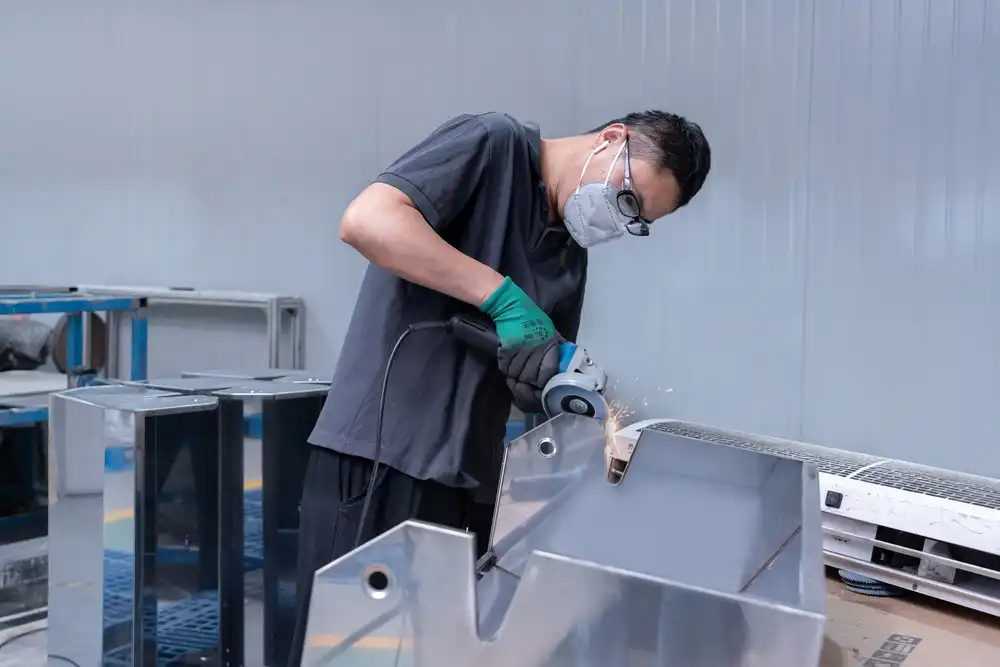
Exposed areas on the firebox, hood, and hood side panels may require grinding and polishing to reduce visible weld marks.
Stainless steel parts also require suitable post-weld cleaning based on their condition. Heat tint, welding oxides, and surface contamination can damage appearance and reduce corrosion performance if they are not properly treated.
For an OEM buyer, welding quality affects much more than appearance.
It influences firebox stability, dimensional consistency, assembly quality, and long-term reliability.
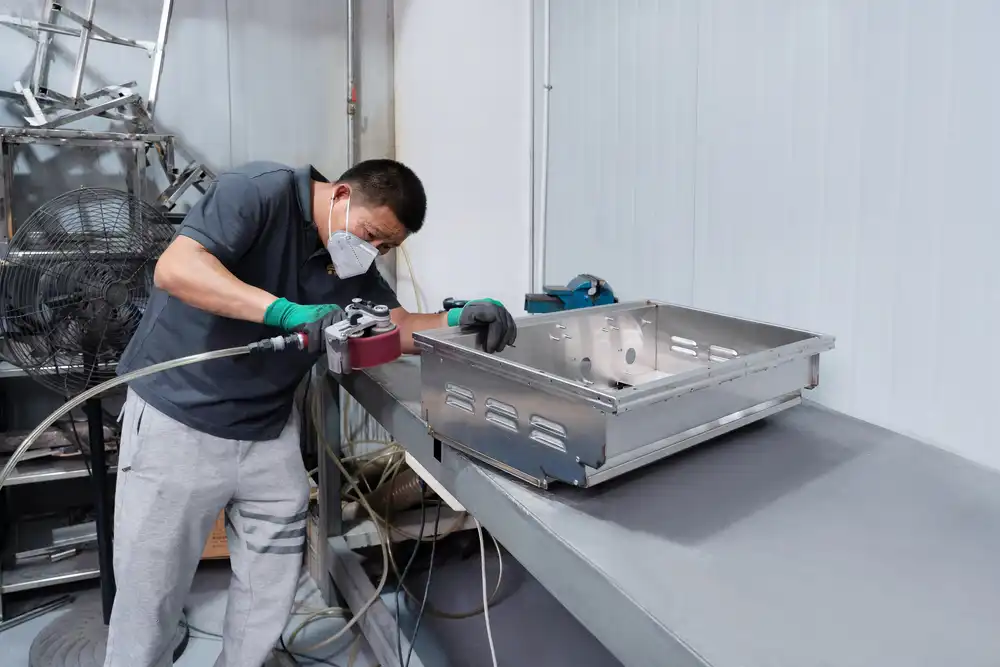
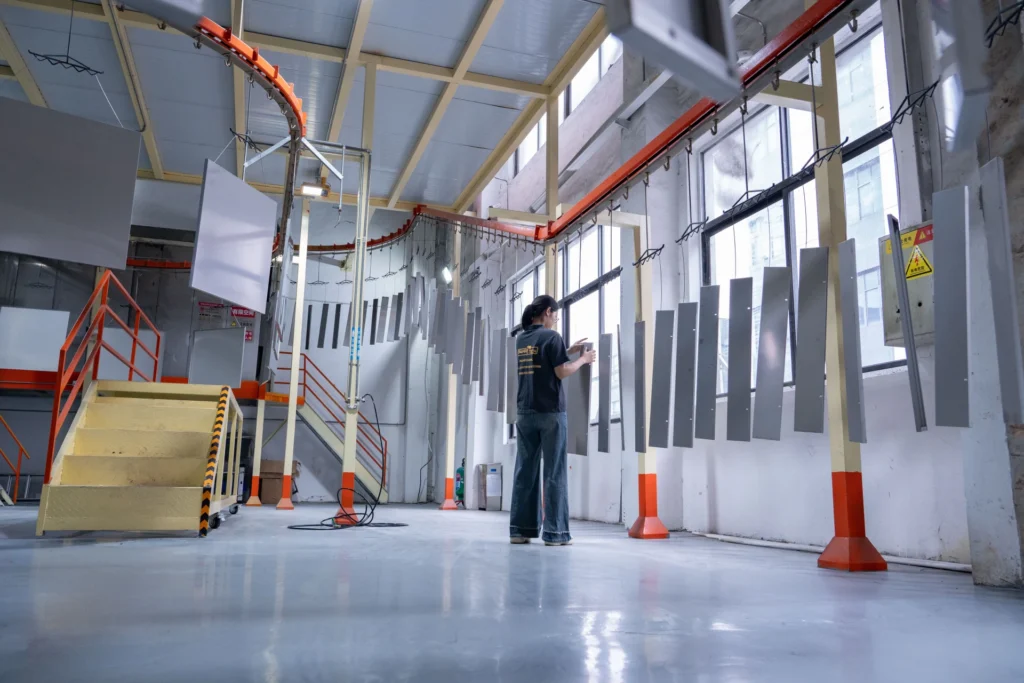
Step 9: Metal Surface Finishing
After welding, the components move through the required surface-finishing operations.
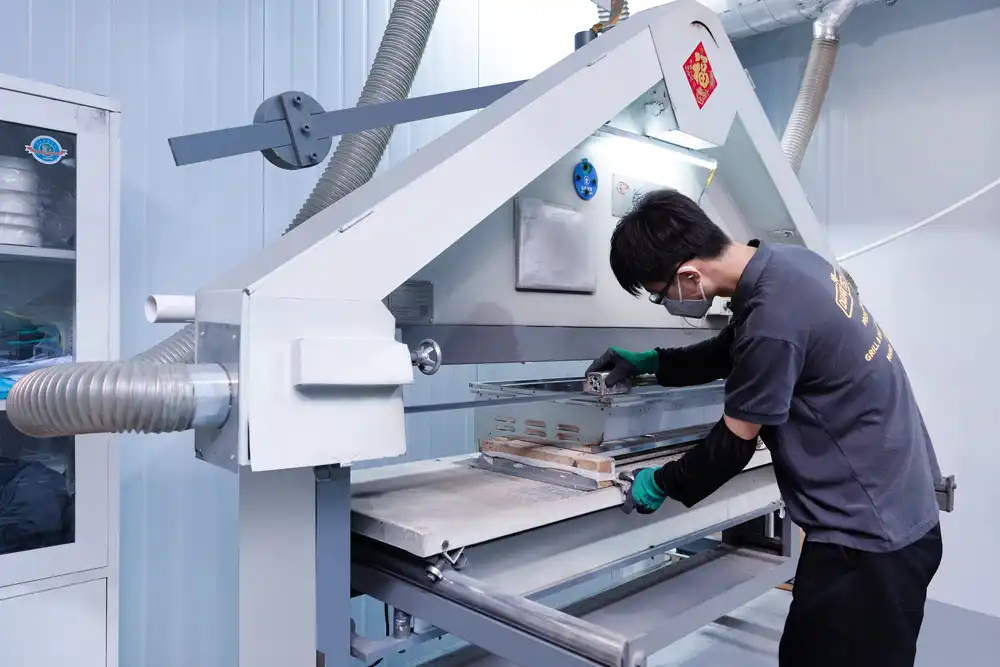
Depending on the product and appearance standard, a series of treatments such as grinding, polishing, shot blasting, sandblasting, passivation and cleaning
Dwarf Grills provides surface grinding, brushing, weld polishing, passivation, and powder-coating solutions.
One configuration currently used by European brand customers combines carbon steel cabinets with environmentally compliant, weather-resistant powder coating. This provides a colored external finish while controlling material and manufacturing costs.
For example, a brand may specify a black modular outdoor kitchen cabinet.
But “black powder coated” is not a complete engineering specification.
Brushed stainless steel also needs controlled grain direction, surface roughness, contamination prevention, and suitable maintenance—especially where coastal salt can increase the risk of tea staining.
Our earlier guide, The Ultimate Guide to Gas Grill Metal Surface Finishes, compares 10 processes, including 2B, brushing, mirror polishing, PVD, powder coating, and electropolishing.
How Many Hours of Salt-Spray Testing Can the Finish Pass?
Salt-spray testing is one method used to evaluate corrosion resistance under controlled test conditions.
For current Dwarf Grills production specifications:
- Powder-coated 201 stainless steel parts are specified for 48–72 hours, depending on the approved coating system and project.
- Selected 304 stainless steel parts are specified for 48 hours, with some configurations reaching 72 hours, depending on the surface condition and project requirement.
Step 10: Burner Manufacturing and Inspection
Dwarf Grills mainly supplies three burner categories. Two are manufactured from stainless steel.
Stamped Stainless Steel Burner
Stamped burner can use 304 stainless steel round tube with a wall thickness of 1.0 mm.
Its main advantage is cost lower than others burners
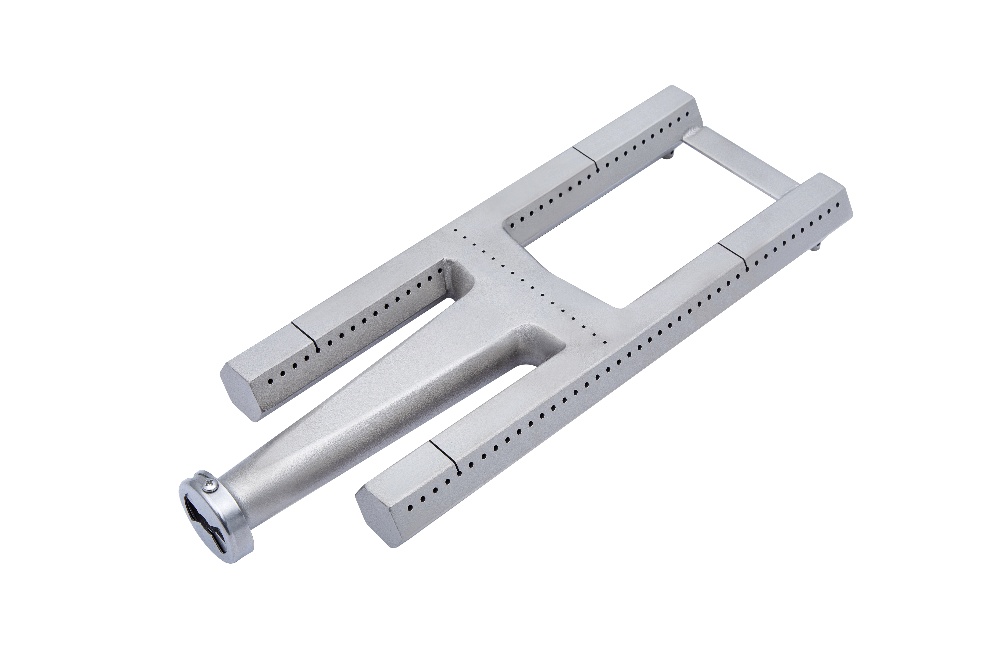
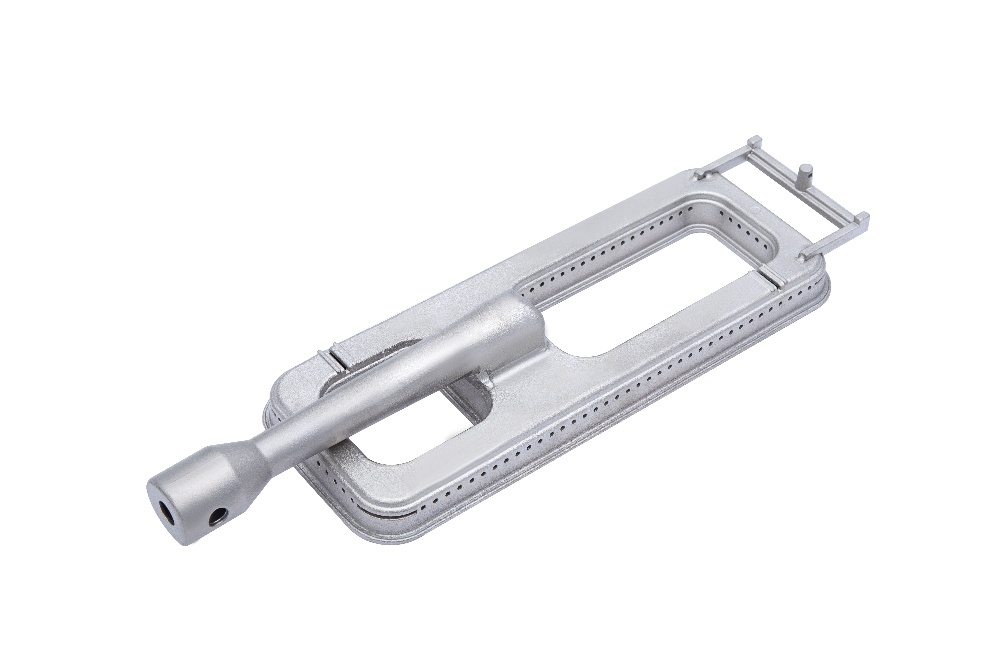
Cast Stainless Steel Burner
Our investment-cast burners are available in structures such as:
- I-shaped
- H-shaped
- Figure-eight
- Three-branch
The burner body is cast in 304 stainless steel and welded to a 3 mm stainless steel cover plate.
This design provides stable combustion and a long service life, but the material and manufacturing cost is higher.
Infrared Sear Burner
An infrared burner normally combines:
- Stainless steel sheet-metal housing
- Ceramic blocks
- Stainless steel protective mesh
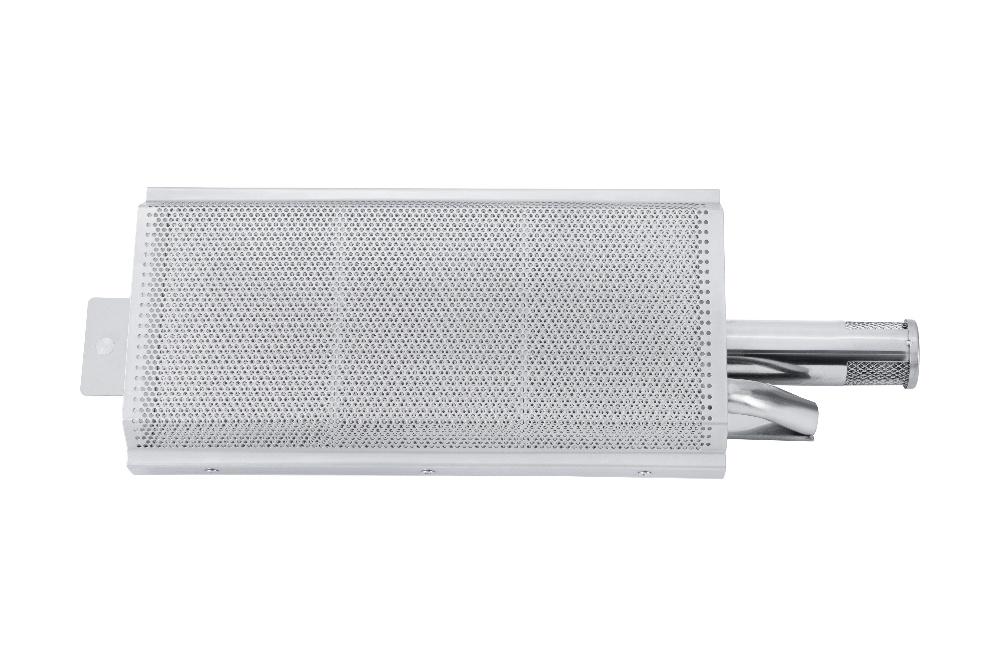
Instead of relying on a conventional visible flame pattern below the grate, the heated ceramic surface produces intense radiant energy.
Its main features include:
- Fast heating
- High cooking temperature
- Even radiant field
- Strong wind resistance
- Flexible side or top placement in suitable designs
The trade-off is a higher cost. The ceramic surface can also be damaged by external impact and needs suitable packaging and handling.
Common main-burner configurations include heat inputs of approximately 12,000–14,000 BTU per burner. The final rating depends on the customer’s design, burner structure, gas type, orifice, pressure, airflow, and certification requirements.
If you need replacement burners compatible with products from brands such as Blaze, Bull, Coyote, or XO, you can contact Dwarf Grills to discuss drawings, dimensions, gas requirements, and parts orders. Brand names are used only to identify the required replacement application; compatibility must be confirmed before ordering.
Step 11: Gas-Control and Ignition-System Preparation
Once the burners are ready, they must be matched with the gas-control system.
This system may include:
- Gas valves
- Manifold
- Orifices
- Regulators
- Hoses
- Igniters
- Ignition electrodes
- Wiring
- Flame-failure devices
For each key purchased component, Dwarf Grills maintains at least three potential suppliers where practical.
Our suppliers for valves, igniters, regulators, hoses, wheels, hinges, and drawer slides include qualified domestic and international manufacturers with relevant production experience and applicable certifications.
In an OEM project, I do not believe every component must be made inside the same factory.
The real requirement is that the components must match correctly.
A good valve connected to the wrong orifice is not a good gas system.
At this stage, component matching and supplier management directly influence final assembly and gas testing.
For mass-production deliveries, we perform incoming sampling and quality checks according to the applicable incoming-inspection plan. In special cases, the project may require 100% inspection.
Step 12: Cooking Grate and Flame-Tamer Manufacturing
Cooking grates and flame tamers may look like two simple parts positioned above the burners.
But they have a clear impact on product cost, heat distribution, cleaning, durability, and the customer’s cooking experience.
How Are Cooking Grates Made?
At Dwarf Grills, solid stainless steel rod grates can use:
- Round rods
- Hexagonal rods
- Square rods
- Triangular rods
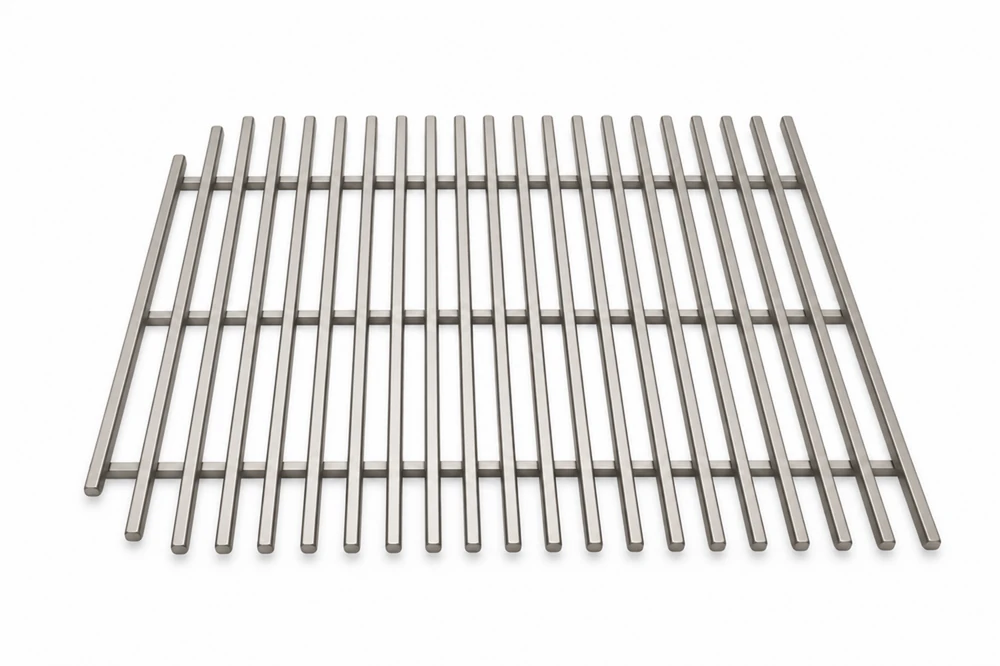
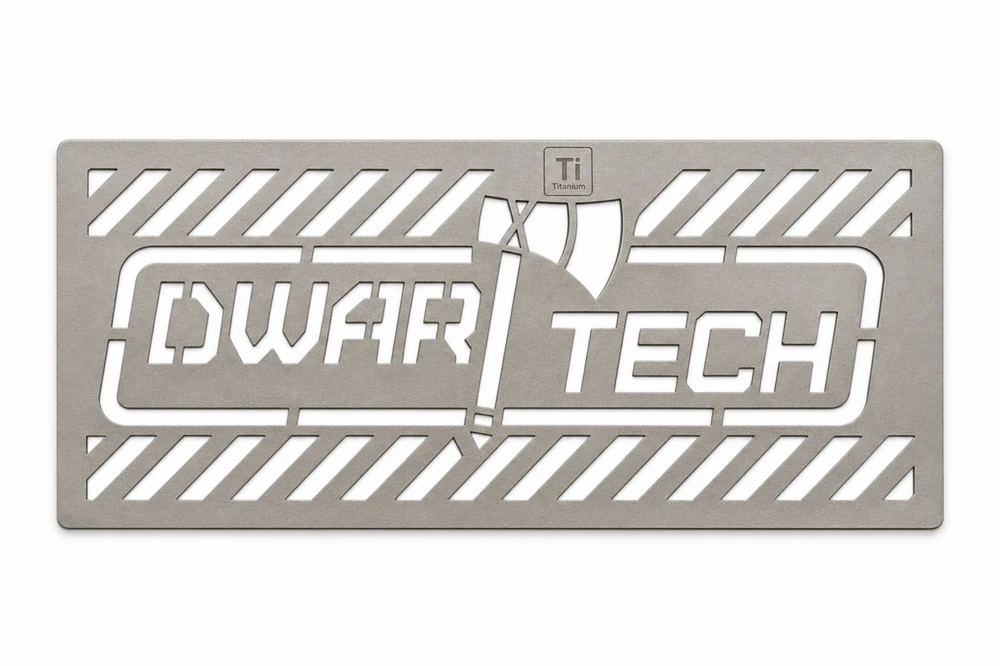
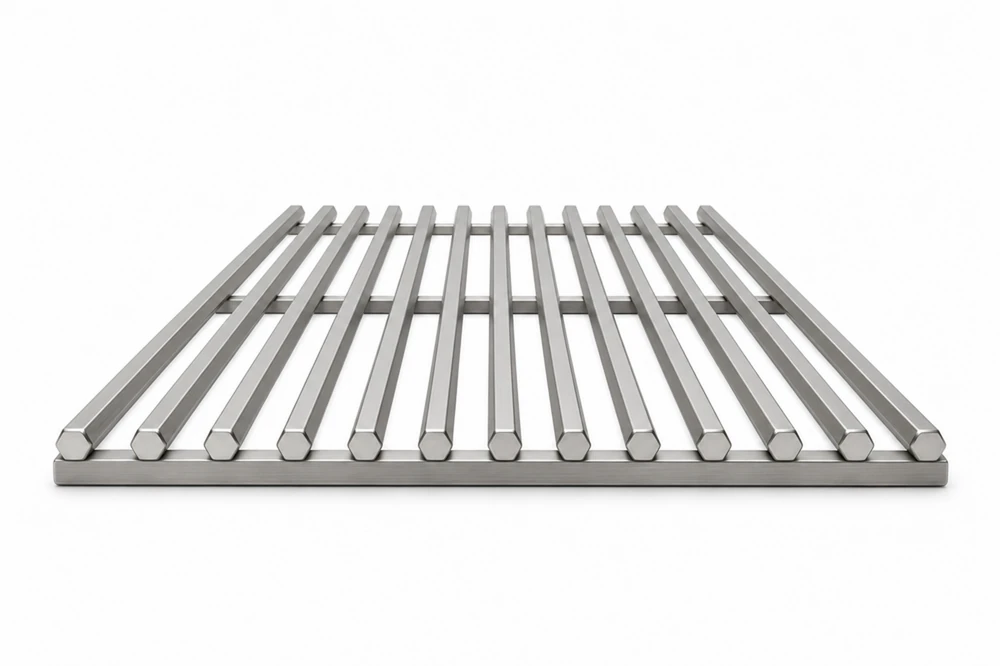
We can also customize cooking grates with brand logos and other approved design features.
Some standard configurations use solid 10 mm hexagonal stainless steel rods.
For premium products, we can evaluate:
- Thick-plate laser-cut grates
- Investment-cast stainless steel grates
- Custom rod structures
- Other engineered cooking surfaces
Different grate designs require different production methods.
Solid rod grates require material cutting, positioning, joining, straightness control, and surface treatment.
Thick laser-cut plate grates require controlled cutting quality, edge treatment, flatness checks, and careful weight assessment.
Investment-cast grates require tooling, casting control, dimensional inspection, and secondary finishing.
How Are Flame Tamers Made?
Perforated stainless steel flame tamers normally require:
- Sheet cutting
- Punching
- Bending
- Edge treatment
- Surface cleaning
Ceramic flame-tamer systems require a suitable ceramic manufacturing process. They must also be validated for the expected heat, impact, grease, cleaning, and shipping conditions.
The choice between stainless steel and ceramic should be based on the cooking goal and complete grill design—not on which material sounds more premium in a product listing.
Step 13: Final Assembly
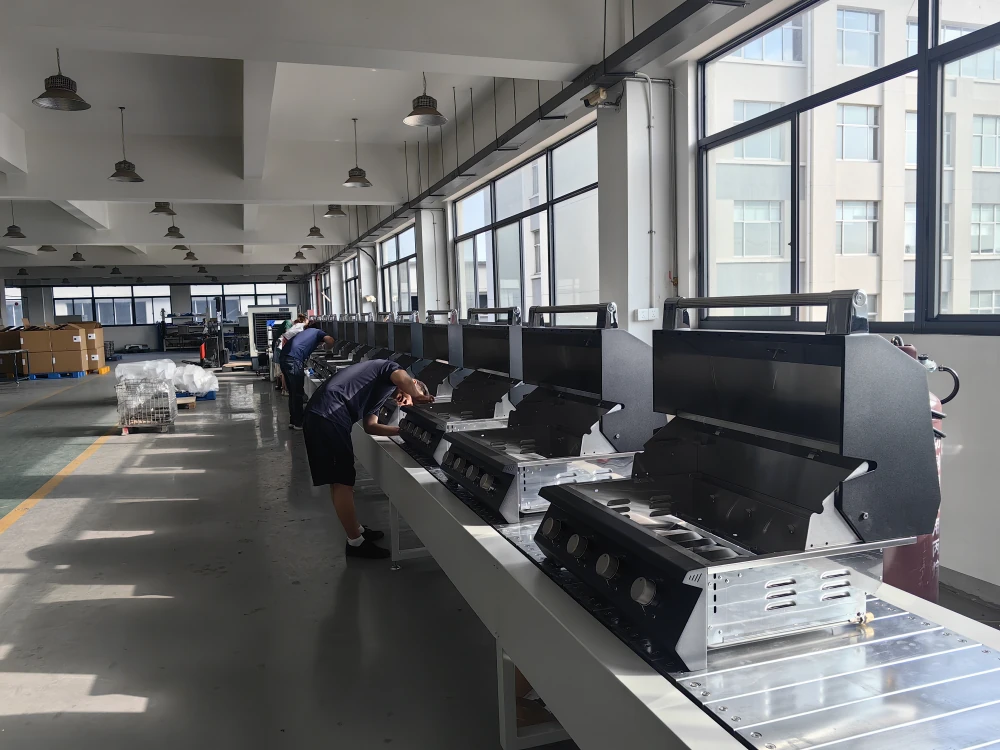
Once the welded structures, burners, gas components, cooking grates, and other parts are ready, the grill enters final assembly.
Workers follow approved assembly drawings and process instructions to install:
- Burners
- Manifold
- Valves
- Ignition components
- Control panel
- Control knobs
- Hood
- Cooking grates
- Warming rack
- Grease-management components
- Lighting and electrical components
- Other accessories
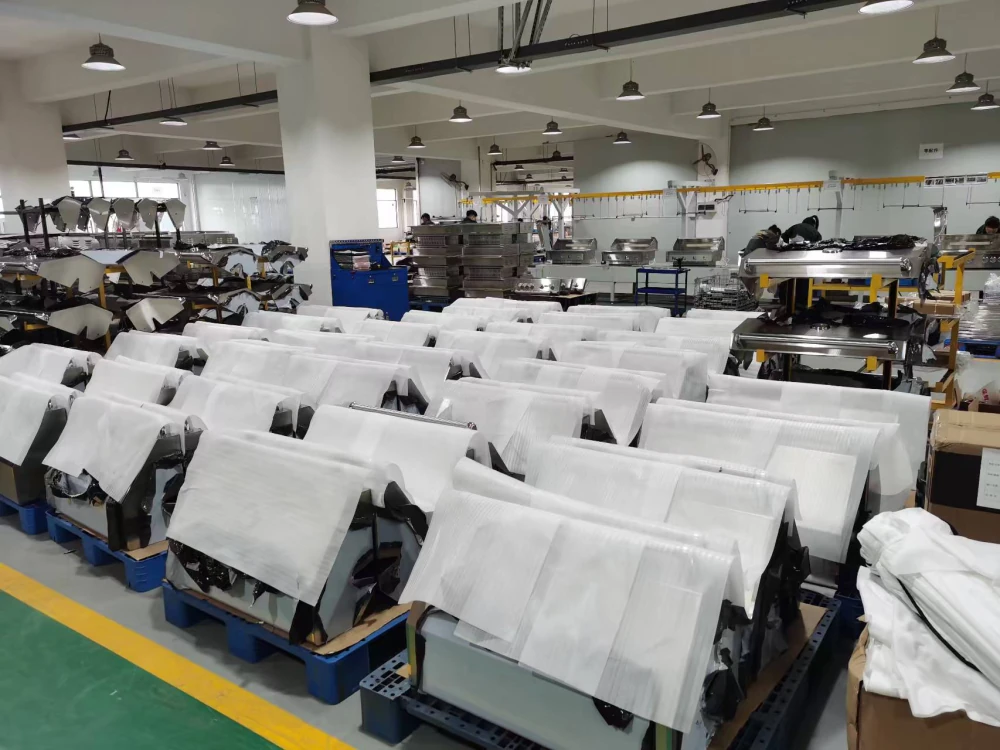
This stage requires careful control of component position, connection reliability, fastening, and assembly order.
For example, the position between a burner inlet and its gas orifice must match the validated design.
Gas connections must be assembled according to the approved process.
Hood hinges, handles, and control knobs must operate smoothly.
Models with LED lighting or smart controls also require wire installation, routing checks, connector checks, and functional testing.
The assembly team must also look for:
- Missing parts
- Wrong components
- Incorrect assembly
- Loose fasteners
- Trapped wires
- Misaligned panels
- Damaged finishes
Final assembly brings every earlier process together. It is also where earlier dimensional errors stop hiding.
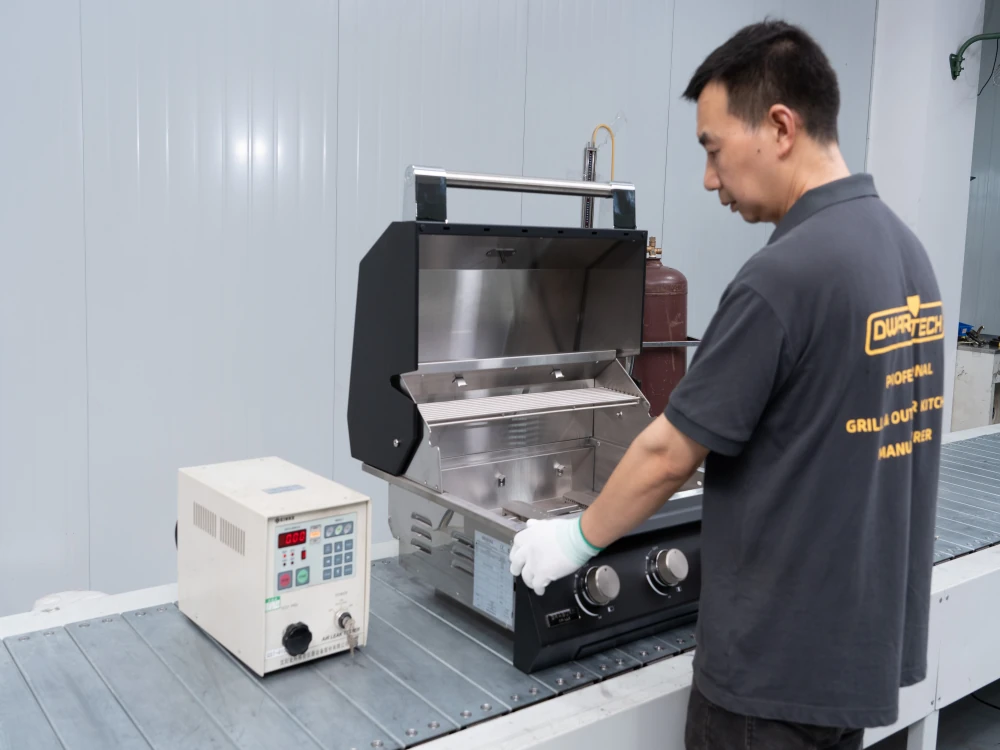
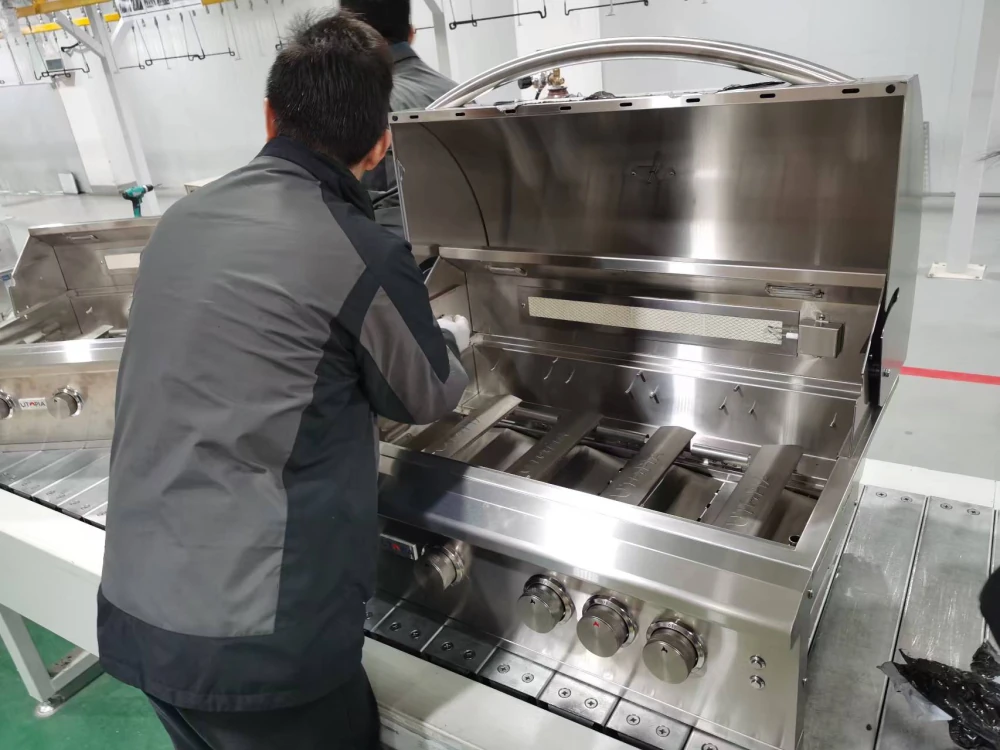
Step 14: Gas Safety and Performance Testing
A fully assembled gas grill is not automatically ready to ship.
Gas safety and operating tests are critical parts of gas grill quality control.
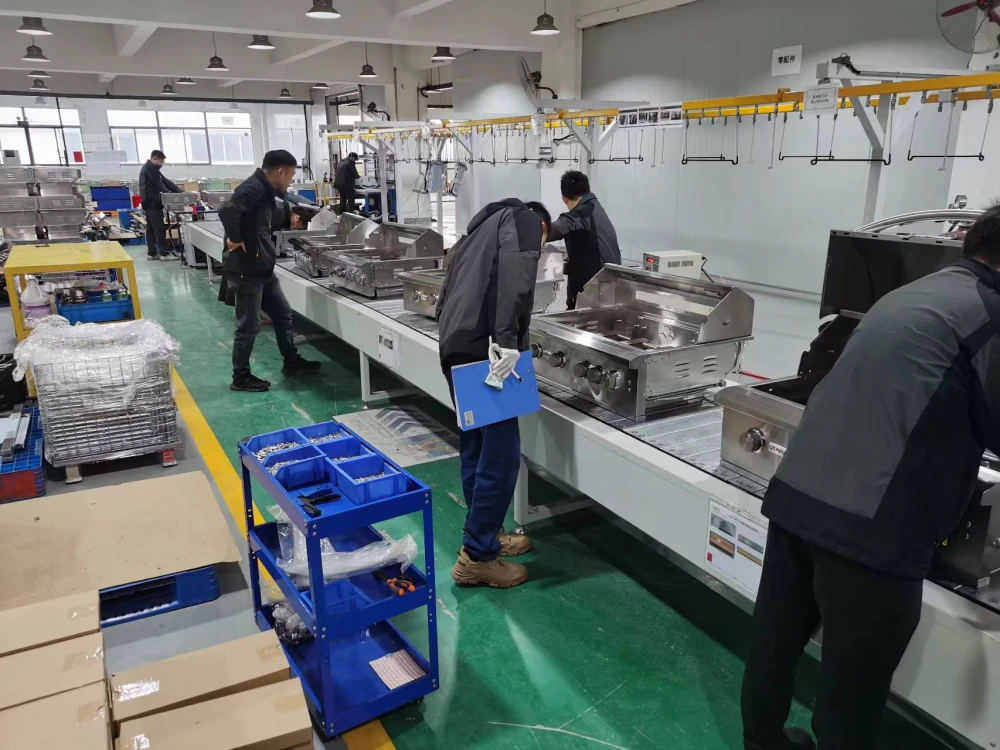
After assembly, Dwarf Grills performs tests that can include:
- Gas-leak testing
- Ignition testing
- Flame-failure protection testing where applicable
- Forced-flame-extinction checks where required
- Flame-stability checks
- Temperature checks
- Burner-by-burner operation
- Full-load operation
Dwarf Grills performs leakage and ignition checks on 100% of completed gas grills.
For relevant current production programs, our internal leak-test setup uses:
- Test pressure: 15 kPa
- Pressure-holding time: 5 seconds
- Acceptance limit: no more than 1.17 mL/min under the defined factory method
These are Dwarf Grills production-control settings for applicable models. They should not be treated as a universal substitute for the complete requirements of every certification standard.
The test pressure, stabilization time, permitted leakage, test medium, equipment accuracy, and acceptance method must follow the approved product specification and applicable market requirements.
For reference, the European Union regulates gas appliances through Regulation (EU) 2016/426 on appliances burning gaseous fuels. North American outdoor cooking gas appliances are commonly evaluated against requirements such as CSA/ANSI Z21.58/CSA 1.6.
Step 15: Final Quality Inspection
After functional testing, the grill moves to final quality inspection.
At this stage, we do not only check whether the product works.
We also inspect its appearance, operation, labeling, accessories, and delivery completeness.
The approved sample, drawings, inspection checklist, BOM, and packaging standard should tell the same story.
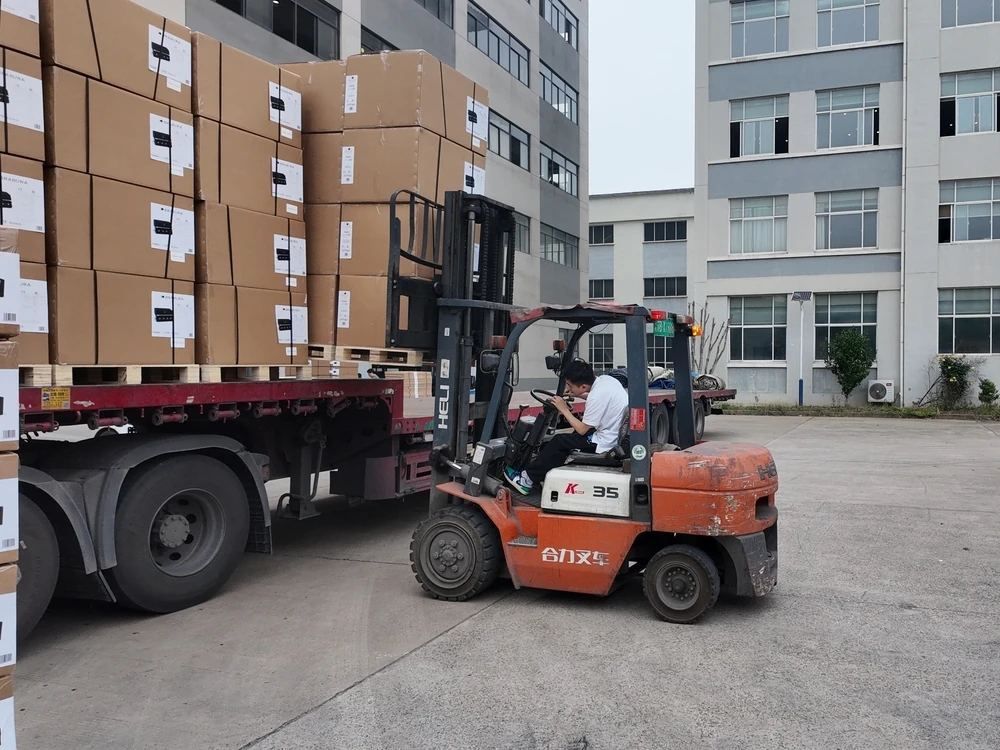
Step 16: Packaging, Warehousing, and Container Loading
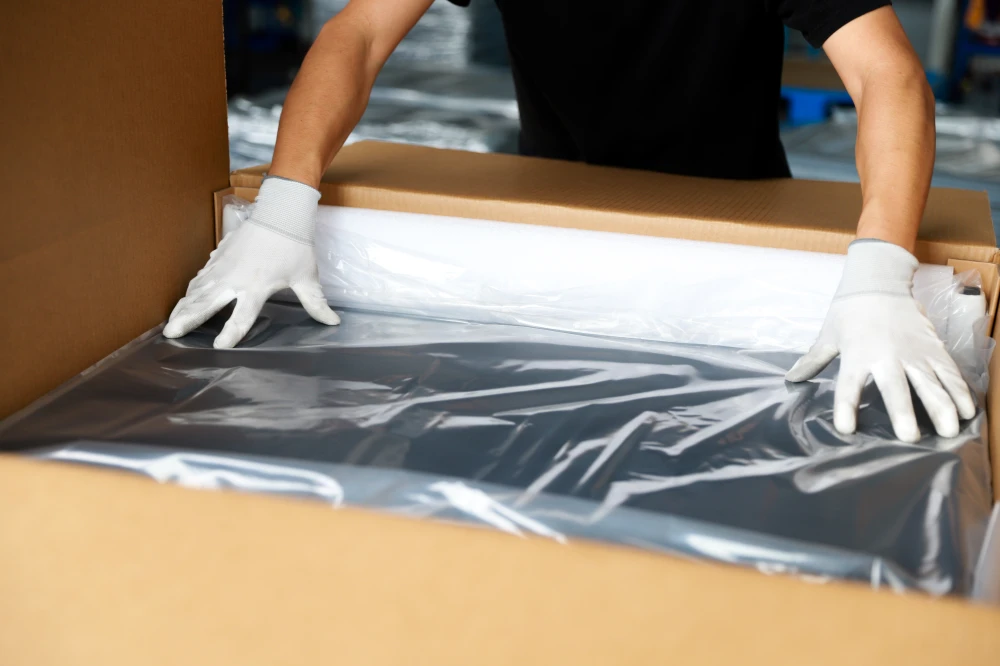
After the grill passes final inspection, it enters the packaging and shipping stage.
For export orders, we select packaging according to:
- Product weight
- Product structure
- Transport method
- Handling risk
- Customer budget
- Destination requirements
How Do We Pack Gas Grills of Different Weights?
Products Below 50 kg
These products normally use a high-strength five-layer K=K corrugated carton with internal cushioning and protective materials.
Products Above 50 kg
Depending on the structure and transport requirements, we may use:
- A pallet with a reinforced carton
- Honeycomb-board reinforcement
- Additional internal supports
Samples and High-Value Customized Products
When necessary, samples and high-value custom products may use wooden cases.
Standard volume orders do not normally use wooden cases unless the product or shipping plan requires them.
How Do We Reduce Shipping Damage?
Common transport damage includes deformation after sheet-metal corners receive an impact.
The most vulnerable areas often include:
- Hood corners
- Control-panel edges
- Cabinet corners
- Side shelves
- Handles
- Ceramic infrared burners
We reinforce and secure these areas according to the product structure. The goal is to reduce impact, vibration, and internal movement during transport.
Do We Support ISTA Packaging Tests?
Yes.
For OEM projects with specific transport requirements, Dwarf Grills can arrange third-party ISTA testing at an additional cost.
The International Safe Transit Association provides several test series, ranging from basic screening procedures to general simulations of transport hazards. The correct procedure should be selected according to product weight, package type, distribution route, and test objective.
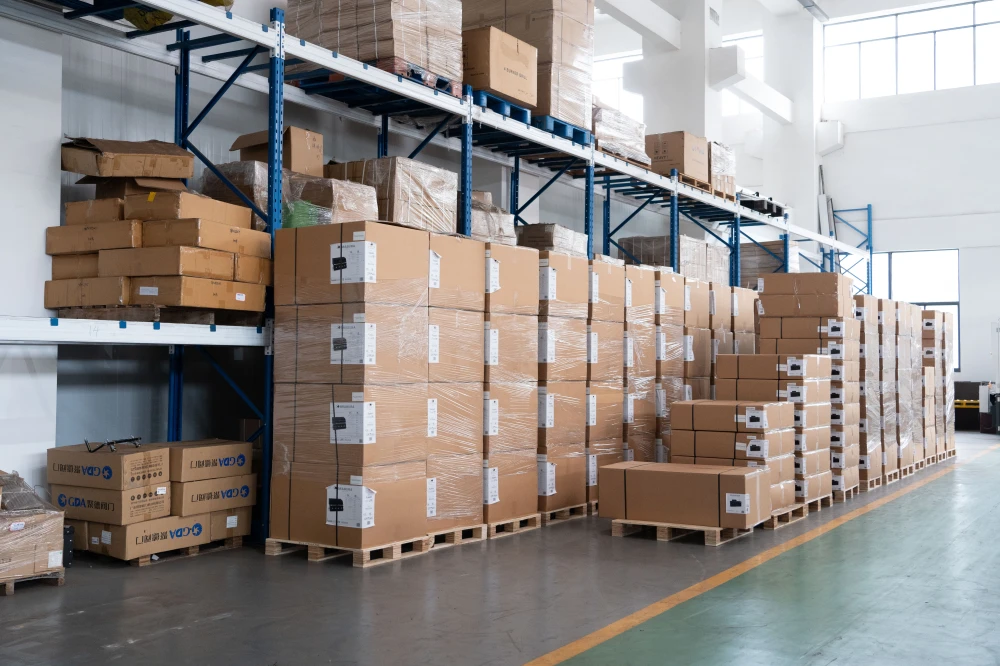
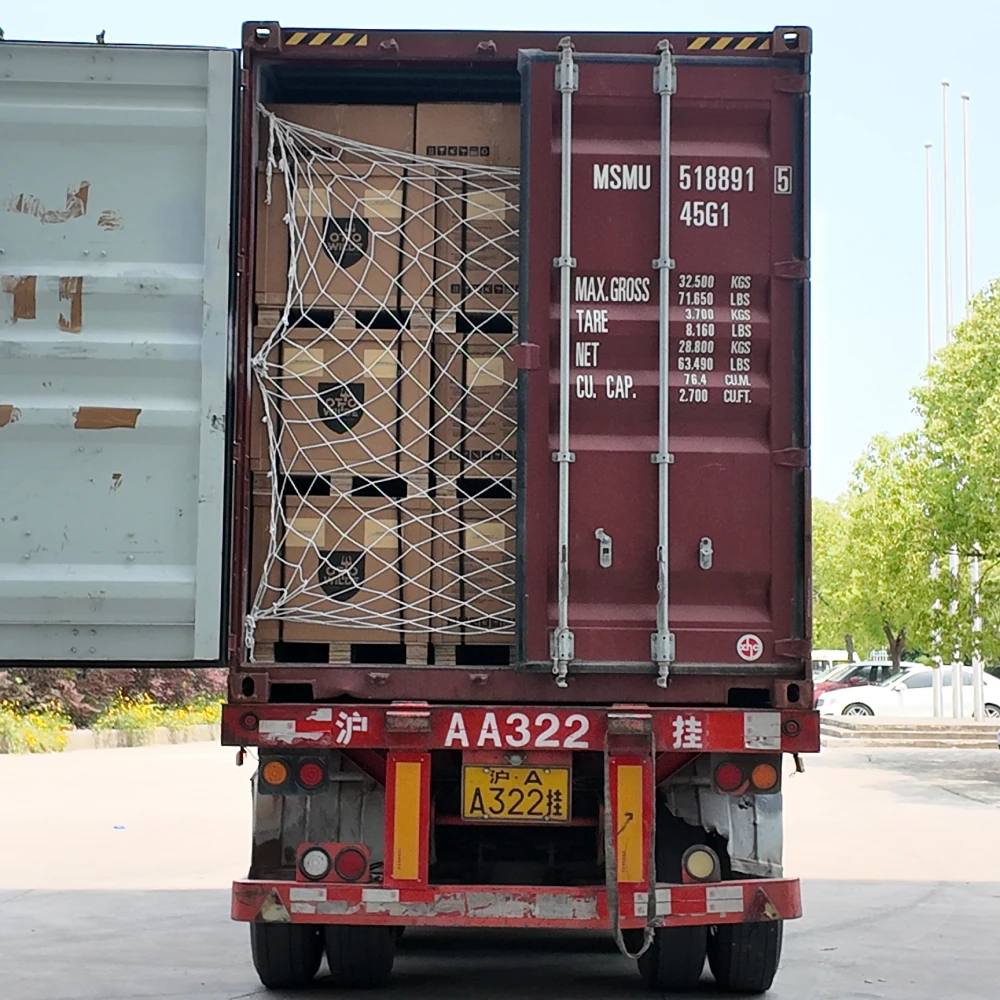
After packaging, finished products are entered into warehouse records, grouped by order, and prepared for container loading.
The loading plan must consider carton dimensions, product weight, container utilization, stacking limits, unloading sequence, and protection against movement.
Frequently Asked Questions
How Long Does It Take to Manufacture a Gas Grill?
The production time depends on whether the product already has a mature design, whether new tooling is required, the purchasing cycle for key components, the certification plan, and the order quantity.
For a completely new OEM product, engineering design, sample development, testing, and certification can add significant time.
For an established standard product, Dwarf Grills can normally complete a sample in approximately 15 days and mass production in approximately 30 days, subject to the final configuration, order quantity, material availability, and confirmed production schedule.
Why Is 304 Stainless Steel Commonly Used in Gas Grills?
Grade 304 stainless steel offers a useful combination of corrosion resistance, formability, weldability, availability, and cost.
That is why manufacturers commonly use it for fireboxes, exterior panels, control panels, and many internal components.
However, grade 304 is not maintenance-free.
In high-salt or high-chloride environments, buyers should also consider surface finish, weld treatment, drainage, cleaning, and alternative material grades.
Is a Cast Burner Better Than a Welded or Stamped Burner?
Neither construction is automatically better for every product.
The right choice depends on:
- Burner structure
- Material
- Wall thickness
- Dimensional accuracy
- Heat input
- Flame performance
- Service-life target
- Replacement strategy
- Manufacturing cost
A stamped stainless steel burner can provide good value for a cost-controlled grill.
An investment-cast 304 stainless steel burner can provide greater mass, structural durability, and a premium product story, but at a higher cost.
The burner should be evaluated as part of the complete combustion system.
Must Every Gas Grill Be Leak-Tested Before Shipment?
Yes.
Dwarf Grills performs 100% leakage testing on finished gas grills.
Gas-system integrity is a critical safety requirement. The exact test pressure, method, leakage limit, and inspection arrangement must comply with the approved product specification and applicable certification requirements.
Sampling may be suitable for certain appearance or dimensional checks. It is not how I would control the final gas integrity of a completed appliance.
What Certifications Are Required for Exporting Gas Grills?
The required certification depends on the target market, product construction, gas type, electrical features, and applicable local law.
Common market frameworks can include:
- European Union: Gas Appliances Regulation and CE conformity requirements
- United States and Canada: certification through recognized bodies using applicable standards, such as ANSI/CSA outdoor cooking gas-appliance requirements
- Australia and New Zealand: applicable gas-appliance certification requirements, plus RCM obligations for relevant electrical or electronic functions
- Eurasian Economic Union: applicable EAC conformity requirements
- Brazil: applicable INMETRO requirements
Projects may also need to consider environmental, chemical, or food-contact requirements such as:
- RoHS
- REACH
- PFAS restrictions or reporting obligations
- FDA food-contact requirements where applicable
- California Proposition 65
- LFGB requirements for relevant food-contact materials
These are not interchangeable certificates.
The exact compliance plan should be confirmed for the product, materials, components, destination, and sales channel before manufacturing begins.
Can an OEM Buyer Visit the Factory During Production?
Yes.
Factory visits, sample reviews, process inspections, and pre-shipment inspections can help buyers compare the approved product with real production.
For a useful visit, I recommend checking more than the equipment list.
Buyers should also review:
- Drawing control
- Incoming inspection
- Material traceability
- Welding fixtures
- Assembly instructions
- Leakage testing
- Golden samples
- Quality records
- Packaging validation
- Change-control procedures
A factory can own many machines and still lack a stable process. Stainless steel does not organize itself out of respect for the equipment brochure.
A Customer Project From Development to Shipment
If you have read this far, you may be wondering whether we have supported customers through the complete process—from customization and sample development to mass production and shipment.
Yes, we have.
I will share one of these customer-development cases in my next article.
The case will show how the product requirements were defined, which manufacturing problems appeared, how the design was improved, and how the final order moved into production and export.
Conclusion
For a brand owner or purchasing manager, the most important question is not how many machines a factory can display.
The real question is whether the factory can turn an approved design into a stable product that can be sold for years.
That requires more than cutting, bending, and welding stainless steel.
It requires controlled engineering, approved materials, matched gas components, repeatable assembly, 100% leakage testing, final inspection, and export-ready packaging.
At Dwarf Grills, we provide OEM and ODM manufacturing support for gas grills, outdoor kitchens, and key grill components for overseas brands, importers, and wholesalers.
If you are developing a new gas grill line, you can send us your product drawings, target market, material requirements, expected order quantity, and certification goals.
Our team can evaluate the project from engineering design and sample development to manufacturing processes, quality requirements, and mass-production planning.
Dwarf Grills—turning your BBQ grill concept into repeatable mass production.
